




Generative AI vs Machine Learning: Key Differences


The debate around generative AI vs machine learning often begins with confusion, not technology. Many companies hear the words throughout, yet they find it difficult to articulate where they overlap, how they differ, and when each should be applied.
This paper sets the ground for better decisions. Leaders need a solid grasp of the fundamental ideas behind machine learning and generative AI, what is the relationship between machine learning and generative AI, and how they suit actual applications before selecting any AI solution. Let us start.
Key Terms: What is Machine Learning? What is Generative AI?
The first step toward making wise judgments about any AI-driven initiative is knowing the fundamentals of AI vs generative AI, vs machine learning.

What is machine learning?
Many teams still inquire whether machine learning is a type of AI. In fact, it is a domain of software engineering that analyzes data, identifies patterns, and uses the patterns subsequently for decision-making.
In simple terms, machine learning is used for tasks that rely on past information to produce a logical outcome.
For example: Predicting monthly revenue, identifying spam emails, recognizing objects in images, or estimating delivery times based on historical traffic data.
Machine learning models depend on algorithms taught on large volumes of already available data. Over time, the system learns which outputs are most helpful and strengthens those. The model has to be retrained and modified as the data changes to guarantee that performance stays correct.
What is Generative AI?
Generative artificial intelligence builds on this basis and spurs many to wonder: Does generative AI use machine learning? Based on the data they were trained on, generative artificial intelligence lets systems generate new data – that is, text, images, or audio. In other words, generative AI is used when you need creative or original output.
Generative artificial intelligence functions really like other machine learning algorithms do in reality. But instead of answering with predictions, generative AI produces something new from scratch based on a prompt or instruction.
For example: Writing emails, generating marketing copy, creating product designs, producing synthetic datasets, or converting ideas into images.
Relationship & Hierarchy: How Machine Learning, Generative AI, and Deep Learning Fit Together
Though not always well understood, the link between generative AI and machine learning is sometimes discussed.
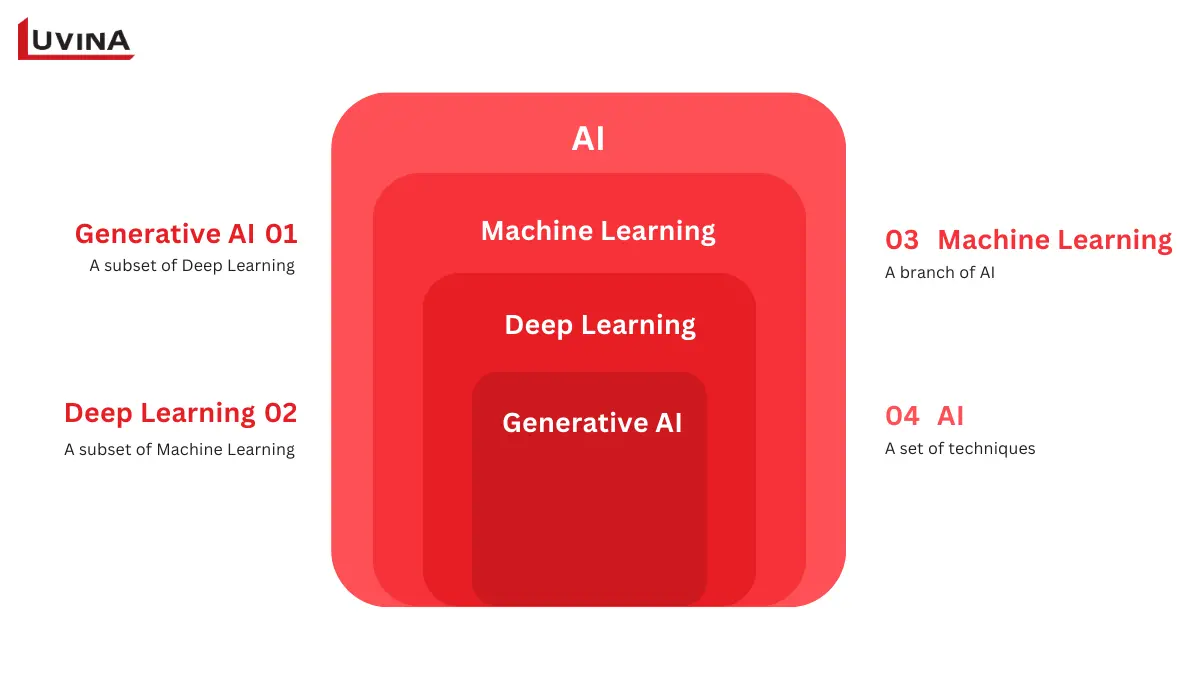
Covering all systems made to simulate human intelligence or behavior, artificial intelligence is the broadest layer. Deep learning can be seen as a more advanced subset of machine learning that utilizes stacks of neural networks to analyze large datasets. While these technologies operate at different levels of the same framework, it also clarifies why there are always debates comparing Gen AI vs machine learning or generative AI vs machine learning vs deep learning.
Generative AI and machine learning cooperate inside this hierarchy. While generative AI gives the ability to produce new data (text, pictures, audio, simulations,…) depending on those acquired patterns, machine learning offers the analytical basis for spotting trends and leading predictions. Understanding how generative AI vs machine learning strengthen each other is essential to grasping their actual significance; less about selecting one over the other.
Already evident throughout sectors is the partnership between the two. Machine learning can enhance generative artificial intelligence by better training data or evaluation methods. Meanwhile, generative artificial intelligence can generate synthetic data for machine learning when authentic data is scarce or expensive.
– While generative artificial intelligence reproduces medication interactions or creates customized medical communication, machine learning in healthcare helps diagnostic predictions.
– While generative artificial intelligence creates fresh songs or artwork, ML influences user suggestions in entertainment.
Comparison: The Differences Of Generative AI vs Machine Learning
To participate in the continuous conversation around generative AI vs machine learning, it is imperative to capture the differences in purpose, products, data needs, and applications between these two technologies. The table below highlights this. Let’s follow.
| Aspect | Generative AI | Machine learning |
| Purpose | Create new content (text, images, simulations) | Analyze data & predict outcomes |
| Output | Content, designs, synthetic data, simulations | Predictions, classifications, recommendations |
| Data requirements | Works well with unstructured/unlabeled data | Requires structured, labeled datasets |
| Learning approach | Mostly unsupervised/semi-supervised | Supervised, unsupervised, reinforcement learning |
| Complexity | High (transformers, GANs, diffusion models) | From simple models to deep networks |
| Best for | Creation, ideation, and automation of content | Prediction, optimization, fraud detection |
| Intepretability | Lower transparency | More interpretable in simpler models |
| Decision-making | Mimics human reasoning and creativity, self-correcting through feedback | Uses statistical models to inform decisions; requires new data or user feedback to adjust |
Key differences of Gen AI vs machine learning
Understanding generative AI and machine learning in this structured way makes it clear that the two technologies complement rather than replace each other. By comparing generative AI and machine learning side by side, businesses can determine which approach – or combination of both – best fits their objectives.
Business Use-Cases & Which Technology to Use When
Often, the complexity of the task, the kind of data at hand, and the desired result help one to choose between generative AI and ML. Businesses may decide when to deploy predictive models against creative, content-generating systems by contrasting generative AI vs machine learning. In many cases, too, a hybrid method makes sense as it combines the benefits of both systems. Knowing the benefits of each of Gen AI vs ML helps companies to choose the ideal solution at the perfect moment.
1. Machine learning use cases
Knowing about generative AI vs machine learning is essential since machine learning is perfect when jobs demand structured data analysis, accurate predictions, or when confidentiality and domain-specific knowledge are most important. It is best used when companies already have strong ML models or highly specialized data that generative AI might not handle as precisely. Among the most well-known applications of machine learning are:
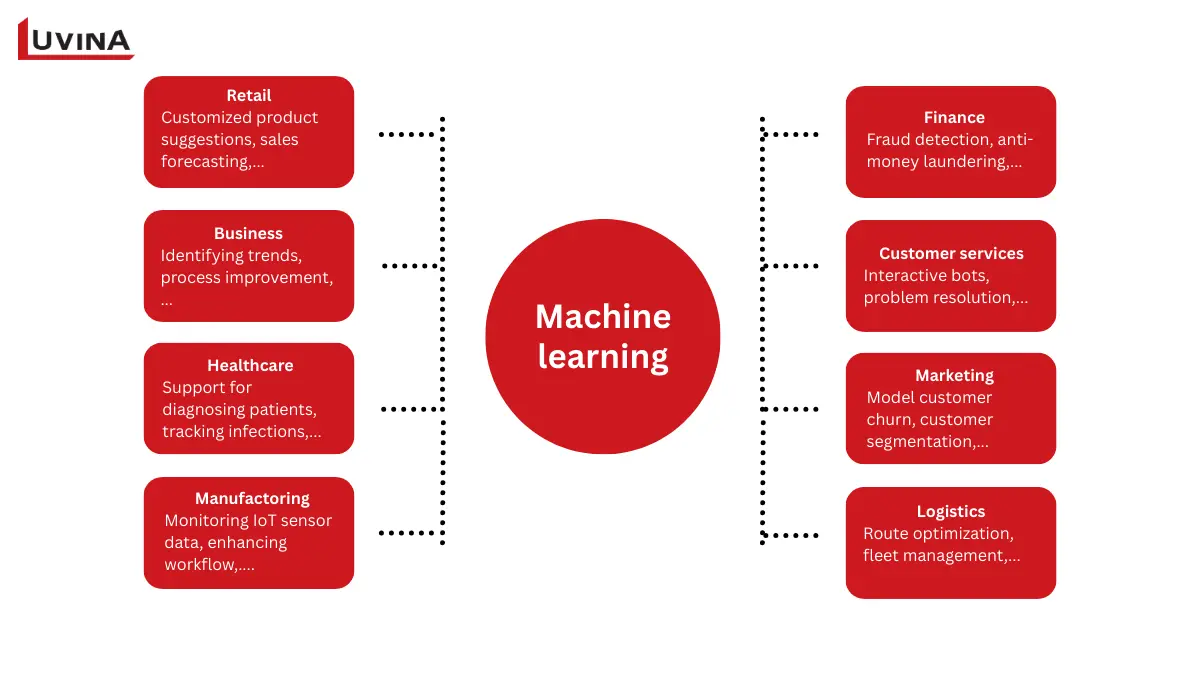
– Retail: Customized product suggestions, sales forecasting, logistical and supply planning using past information.
– Business: Identifying trends, process improvement, determining bottlenecks in processes, and forecasting business results.
– Healthcare: Support for diagnosing patients, tracking infections, and predictive analytics for treatment plans. DeepMind, a research company owned by Alphabet, develops advanced ML models for medical imaging and diagnostics. In a project with Moorfields Eye Hospital, its system detected more than 50 eye diseases with accuracy comparable to expert ophthalmologists.
– Manufacturing: Monitoring IoT sensor data, enhancing workflow for production, and predicting maintenance.
– Financial services: Fraud detection, anti-money laundering, personalized financial planning, and optimization of workflows.
– Customer service: Interactive bots providing assistance with FAQs, problem resolution, and triaging support tickets.
– Marketing: Model customer churn, customer segmentation, and targeting customers for more effective campaigns based on analysis. For example, ML helps platforms like Amazon and Netflix suggest products or shows by analyzing what users have viewed, clicked, or purchased before.
– Logistics & transportation: Route optimization, fleet management, predictive maintenance with sensor data and traffic data.
2. Generative AI use cases
Tasks including unstructured data, creative content, or natural language understanding are where generative artificial intelligence shines. Particularly successful when speed, accessibility, and inventiveness are top objectives. Comparing generative AI vs ML, generative AI may frequently replace more basic ML processes, as well as allow new applications that conventional models cannot manage. Here are some uses for GenAI across industries:

– Retail: Dynamic planograms, virtual try-ons, custom promotions, automated product descriptions, product image creation.
– Business: Ideas from unstructured data (emails, catalogs, reports), semantic analysis of papers, sophisticated chatbots for automated assistance. HubSpot is a CRM platform that uses AI to streamline sales operations. Its features include automatic lead scoring, email sequencing, and pipeline management. HubSpot’s generative AI helps sales teams predict customer behavior, personalize outreach, and automate repetitive tasks, boosting efficiency and conversion rates.
– Healthcare: Automated transcription and summarization of clinical notes, picture analysis, and customized treatment planning.
– Manufacturing: Design creation and optimization, process simulations, predictive diagnostics, repair and maintenance advice.
– Finance: Advisory services, automated portfolio strategy, natural language stock screening, and massive financial document processing. Featurespace’s ARIC platform uses generative AI to detect and prevent fraud in real time. It learns from each transaction to create models that spot anomalies and suspicious behavior, strengthening financial security.
– Customer service: Context-aware chatbots, sentiment-sensitive virtual assistants, and real-time user interaction management.
FAQs
Is AI the same as Machine Learning?
No. Machine learning is a subset of AI focused on learning patterns from data. AI is broader and includes reasoning, planning, automation, and generative models.
Is generative AI a subset of AI?
Yes. Generative AI uses deep learning architectures to produce new content based on learned patterns.
What is the main difference between machine learning and Generative AI?
Machine learning predicts outcomes from existing data, while generative AI creates new data such as text, images, or code.
Can machine learning and Generative AI work together?
Absolutely. ML identifies patterns; GenAI uses those insights to generate customized content or new datasets.
What are the key ethical concerns of Generative AI?
Bias, data privacy, misinformation, and deepfake misuse. Organizations must apply governance and a transparent model for monitoring.
Conclusion
Effective use of artificial intelligence in today’s business environment depends on knowing the differences between generative AI vs machine learning since both enable better efficiency and present fresh expansion possibilities. The secret is to see how generative AI and machine learning can complement each other rather than to pick one over the other.
At Luvina, we provide tailored solutions based on the strengths of each technology. We have a staff of more than 750 experts to help you enhance decision-making, automate processes, or build something new with AI creativity.
Explore how generative AI and machine learning can revolutionize your company – Start today and get in touch with us.
Resources
- https://www.n-ix.com/generative-ai-vs-machine-learning/
- https://www.missioncloud.com/blog/generative-ai-vs-machine-learning
- https://indigo.ai/en/blog/generative-ai-vs-machine-learning/#generative-ai-vs-machine-learning-synergies-between-the-twonbsp
- https://www.simplilearn.com/generative-ai-vs-machine-learning article#key_differences_between_machine_learning_and_generative_ai
- https://www.techtarget.com/searchenterpriseai/tip/Generative-AI-vs-machine-learning-How-are-they-different
- https://www.forbes.com/sites/bernardmarr/2024/06/25/the-vital-difference-between-machine-learning-and-generative-ai/
- https://mitsloan.mit.edu/ideas-made-to-matter/machine-learning-and-generative-ai-what-are-they-good-for
- https://www.ibm.com/think/topics/machine-learning-use-cases
- https://nix-united.com/blog/machine-learning-in-healthcare-12-real-world-use-cases-to-know/#id-top-12-use-cases-of-machine-learning-in-healthcare
- https://www.eweek.com/artificial-intelligence/generative-ai-examples/
READY TO START A PROJECT?
Our experts are eager to explore your needs.


Read More From Us?
Sign up for our newsletter
Read More From Us?
Sign up for our newsletter