




SQL vs NoSQL: Choosing the Right Database Model


MSQL vs NoSQL is a decision about data structure, consistency, and scalability.
SQL databases prioritize strong data integrity and structured relationships. NoSQL databases are designed for use in distributed systems, offer flexible schemas, and support cloud-native workloads.
We will analyze in this article how SQL and NoSQL databases function, contrast their pros and cons, investigate actual uses, and assist you in selecting which database model most suits the demands of your program. There is no universal winner. The right choice depends on data type, growth patterns, and performance requirements.
What Are SQL (Relational) Databases?
A SQL database is “a type of database that uses Structured Query Language (SQL) to store, manage, and retrieve structured data in a relational format.” It acts much like a well-structured database with rows and columns, allowing for quick access, updating, and analysis of data. SQL databases have stayed a fundamental component of corporate systems for decades, mostly because of this exact structure.
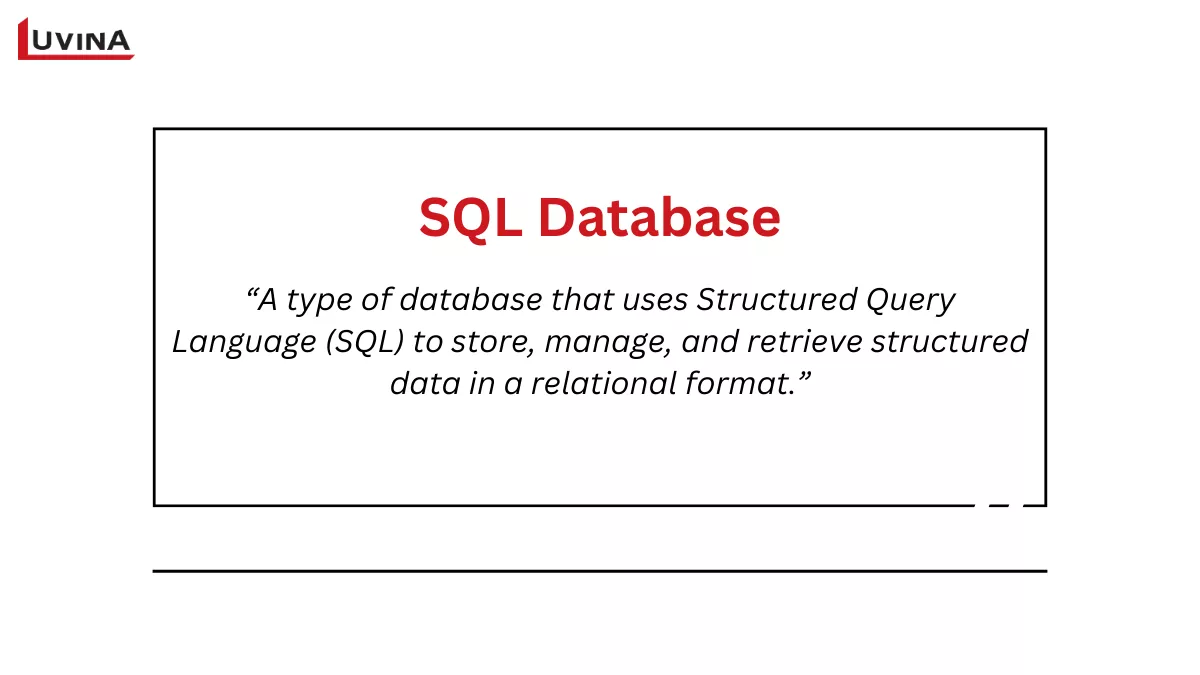
The definition of SQL databases
Among the main features of SQL databases are:
– Structured tables with rows and columns house data.
– A predetermined plan guarantees data validity and consistency.
– SQL allows for flexible queries spanning several linked tables.
– Compliant ACID guarantees dependable and correct transactions.
SQL databases are best suited for systems where consistency and transactional reliability are critical.
What Are NoSQL (Non-Relational) Databases?
A NoSQL database is “an approach to database design that enables data to be stored and queried outside the traditional structures of relational databases.” Unlike traditional database management systems (DBMS), which store data in tabular formats with strict definitions for each column (and therefore all rows in the table), NoSQL uses a variety of other ways to store data that allow for greater flexibility in how applications can work with constantly changing data types or large amounts of data.
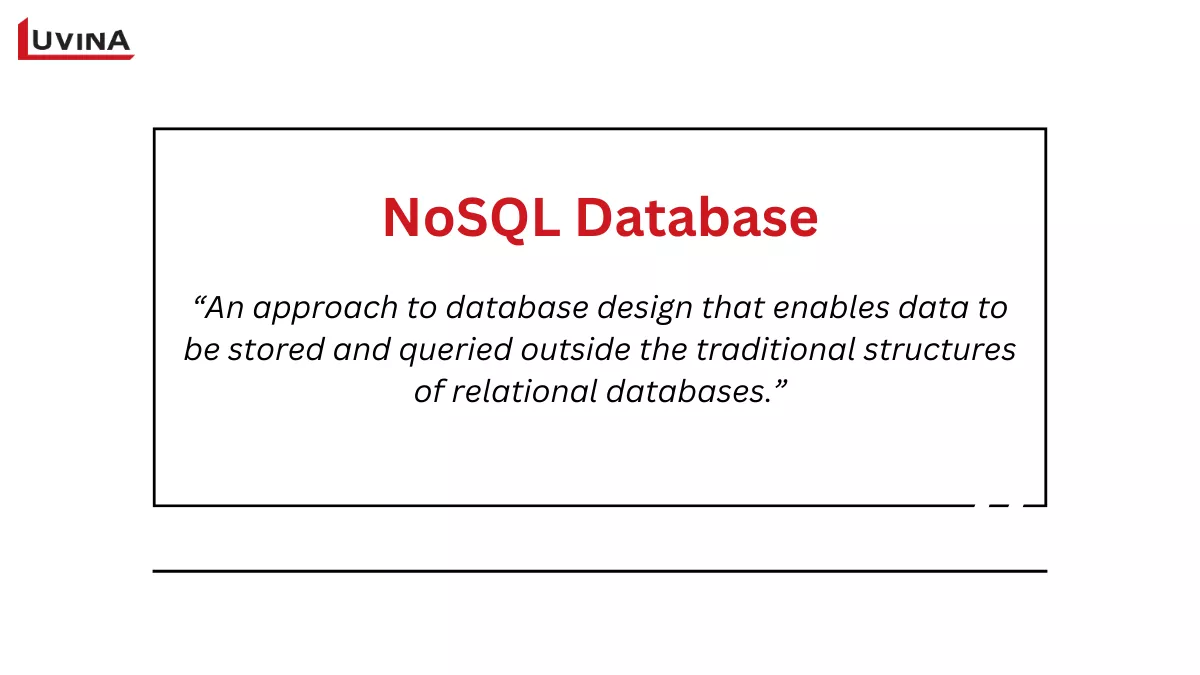
The definition of NoSQL databases
Among NoSQL databases’ main features are:
– Flexible structures, such as JSON documents, store data.
– Schemas are fluid and enable quick adjustments without redesign.
– Distributed design raises dependability and availability.
– Large, rapid data volumes benefit from horizontal scalability.
NoSQL databases are optimized for rapid development, real-time data, and cloud-native architectures.
Difference Between SQL and NoSQL
From a data engineering perspective, developing dependable data pipelines requires knowledge of the structural and scalability differences between SQL and NoSQL databases. Though both kinds of databases serve the same main purpose – storing, retrieving, updating, and deleting data – the design and behavior under size define the difference between relational and non relational database.
| Category | SQL (Relational databases) | NoSQL (Non-relational databases) |
| Core concept | Focuses on structured, table-based data models. | Emphasizes flexible, non-tabular data storage. |
| Data model | Data is stored in tables with rows and columns. | Data is stored as documents, key-value pairs, or graphs. |
| Data type | Designed mainly for structured data. | Supports structured, semi-structured, and unstructured data. |
| Schema | Uses a predefined and fixed schema. | Uses a dynamic schema that adapts to changing data. |
| Scalability | Scales vertically by increasing server resources. | Scales horizontally by adding more servers. |
| Query language | Uses SQL with a standardized syntax. | Uses JSON, XML, YAML, or binary formats. |
| Data integrity | Enforces strict ACID compliance. | Follows BASE principles with eventual consistency. |
| Performance | Relies on optimized disks, indexes, and query design. | Depends on network latency, cluster size, and distribution. |
| Transaction handling | Strong support for complex multi-row transactions. | Prioritizes availability over immediate consistency. |
| Support and maturity | Mature ecosystem with broad community support. | Support varies by database system and use case. |
| Examples | Oracle, PostgreSQL, MS SQL Server. | MongoDB, Redis, Cassandra, Neo4j. |
| Best for | Transactions, reporting | Real-time, large-scale systems |
SQL vs NoSQL comparison table
When to Use SQL vs NoSQL (Use Cases)
The SQL vs NoSQL argument has no clear winner. The important issue is not which database is preferable but rather which one matches a certain application. To help you to choose between relational and non-relational databases based on real operating requirements, the following parts define when SQL is the preferred choice and when NoSQL gets the more appropriate option.
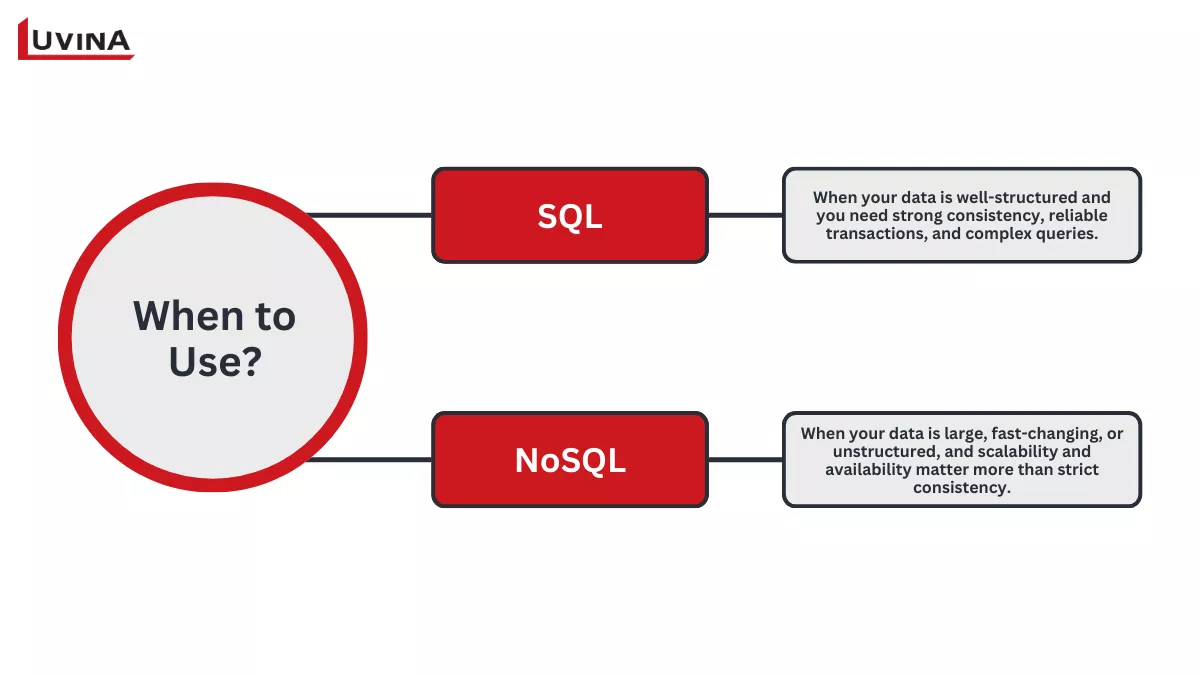
Use cases of SQL and NoSQL databases
When to use SQL?
When data relationships are important and correctness has to be guaranteed at all times, SQL databases are a great choice. They perform best in conditions with organized data, frequent transactions, and non-negotiable consistency. SQL is sometimes favored in the SQL vs NoSQL comparison for systems depending on real-time updates and complicated searches across related data.
Common uses of SQL are found in the following situations:
– Handle managed corporate data with defined relationships.
– Creating mobile or online programs that record transactions and user accounts
– Executing business intelligence and reporting duties
– Supporting data warehousing and analytic queries
– Managing systems that are heavy in transactions, including e-commerce and banking
– Handling cloud-based relational databases for business apps
– Enabling recommendations algorithms in music and media channels.
When to Use NoSQL?
When speed, scalability, and flexibility outweigh rigorous consistency, NoSQL databases are perfect. They are intended to manage high volumes of often-changing data or do not match well into set schemas. SQL vs NoSQL decisions in many contemporary architectures favor NoSQL for distributed, cloud-native, and high-availability systems.
Common uses of NoSQL are:
– Handling and storing great amounts of semi-structured or unstructured data
– Encouraging real-time web, mobile, and IoT uses
– Providing real-time recommendations and personalization
– Developing high-availability messaging and social media platform systems
– Controlling delivery of material, catalogs, and inventory at scale
– Identifying fraud and encouraging systems of identity verification
– Fueling platforms for gaming, e-learning, ad tech, and analytics.
In many real-world systems, the most effective approach is to combine SQL and NoSQL rather than choosing one over the other. SQL handles structured, transaction-heavy data while NoSQL supports scalable, high-volume, or real-time workloads.
Using both together is common in scenarios such as:
– SQL for core business data like users, orders, payments, and reporting.
– NoSQL for real-time events, logs, caching, personalization data, or large-scale content.
SQL ensures data integrity, while NoSQL improves performance and scalability.
This approach enables systems to remain reliable while scaling efficiently as data and user demands increase.
Examples of SQL and NoSQL Usages
Rarely do real-world systems depend on one database paradigm. Companies, therefore, sometimes combine SQL and NoSQL to satisfy several technological needs under the same platform. These examples demonstrate how SQL vs NoSQL manifests itself in reality.
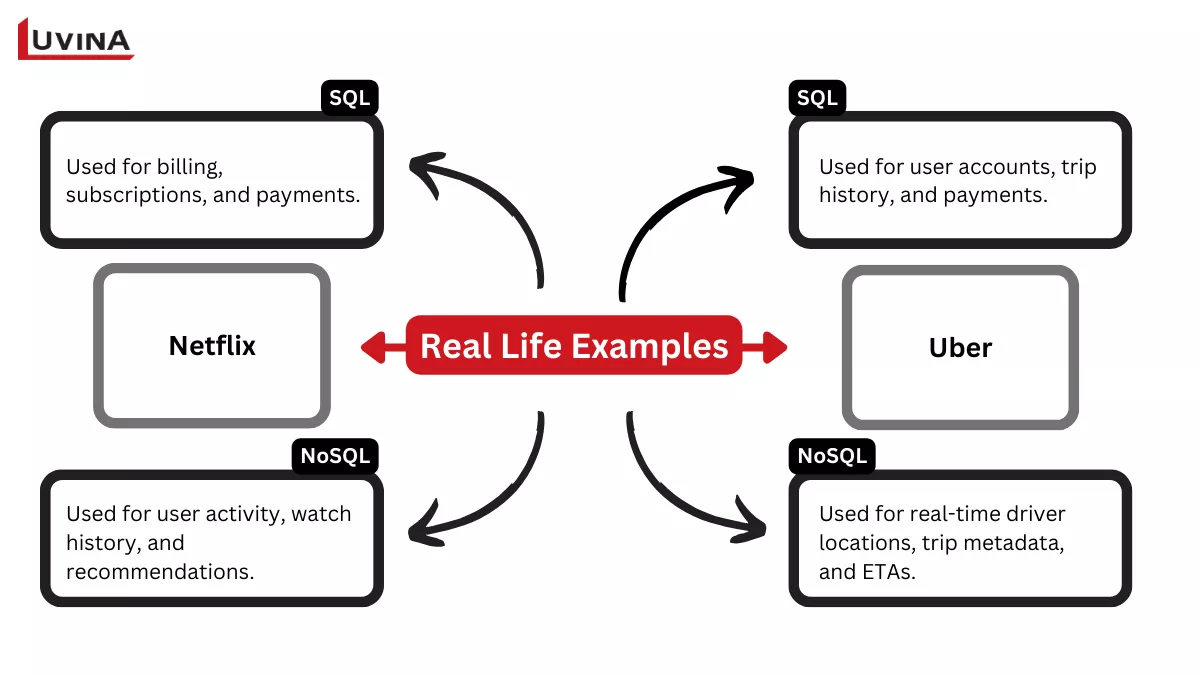
How SQL and NoSQL are used in real-world applications
Netflix: Scalability meets data accuracy
Alongside sensitive billing information, Netflix processes large quantities of user behavior data. Netflix uses Cassandra, a distributed NoSQL database built for horizontal scaling and high availability across several areas, for user behavior data, including watch history and recommendations. This enables quick data access and worldwide continuous service.
MySQL underpins Netflix’s billing, subscriptions, and payments.MySQL offers great consistency and ACID transactions as a SQL database, hence guaranteeing every financial transaction is dependable and correct. This effective SQL vs NoSQL approach allows Netflix to grow worldwide while safeguarding sensitive financial information.
Uber: Real-time data with transactional safety
Uber’s platform uses real-time data to find riders and drivers, monitor rides, and compute ETAs. Supporting this, Uber gives low latency and great availability priority by using NoSQL systems with flexible schemas to store dynamic location and travel information. For faster access to commonly asked information, Red is also employed as an in-memory store.
Uber uses MySQL for user accounts, trip logs, and payment processing. Strict consistency and transactional safety are necessary in these regions to prevent mistakes or conflicts. This divide certainly demonstrates how SQL vs NoSQL decisions fit with various data needs inside the same application.
FAQ
1. Is NoSQL faster than SQL?
NoSQL can be faster for large-scale and real-time workloads, while SQL performs better for complex queries and transactional operations
2. Should I use SQL or NoSQL for a new application?
Use SQL for structured data and strong consistency needs, and NoSQL for scalable systems with flexible or rapidly changing data.
3. Can SQL and NoSQL be used together in one system?
Yes, many architectures use SQL for transactional data and NoSQL for high-volume or real-time data in SQL vs NoSQL systems.
4. Which is better for scalability, SQL or NoSQL?
NoSQL scales horizontally by adding servers, while SQL usually scales vertically by upgrading hardware.
Conclusion
SQL and NoSQL are complementary, not competing technologies.
The best choice depends on how your data evolves, how your system scales, and how much consistency you require.
In many cases, the optimal architecture is not SQL or NoSQL, but SQL and NoSQL together.
Glossaries
1. SQL (Structured Query Language)
A standard language used to store, query, and manage structured data in relational databases.
2. NoSQL
A type of database designed to store and process data outside traditional table-based structures, often used for large-scale or unstructured data.
3. Schema
The defined structure that determines how data is organized in a database, including tables, fields, and data types.
4. ACID Compliance
A set of rules (Atomicity, Consistency, Isolation, Durability) that ensure database transactions are processed accurately and reliably.
5. BASE Principle
A consistency model for many NoSQL systems that stands for Basically Available, Soft state, and Eventually consistent.
Resources
- https://azure.microsoft.com/en-us/resources/cloud-computing-dictionary/what-is-sql-database
- https://www.ibm.com/think/topics/nosql-databases
- https://www.ibm.com/think/topics/sql-vs-nosql
- https://www.coursera.org/articles/nosql-vs-sql
- https://aws.amazon.com/compare/the-difference-between-relational-and-non-relational-databases/#key-differences-relational-vs-non-relational-databases–dge7el
- https://www.tencentcloud.com/techpedia/100278
- https://www.simplilearn.com/top-applications-of-sql-article
- https://aws.amazon.com/nosql/
- https://cloud.google.com/discover/what-is-nosql#sql-versus-nosql-use-cases-and-examples
- https://strapi.io/blog/sql-vs-nosql
- https://www.linkedin.com/pulse/sql-vs-nosql-comprehensive-comparison-real-world-examples-sikdar-s4sqf/
- https://viblo.asia/p/nhung-diem-khac-biet-giua-sql-va-nosql-gGJ59b4rKX2
READY TO START A PROJECT?
Our experts are eager to explore your needs.


Read More From Us?
Sign up for our newsletter
Read More From Us?
Sign up for our newsletter