




What Is Aras PLM: Features, Uses & System Overview


You are not alone if you have ever questioned what is Aras PLM. Managing complicated product data effectively is now essential in the fast-moving product development environment. This article will guide you through PLM definitions by Aras, then give you a clear Aras PLM overview, so you can see why this platform stands out in the market. Keep reading to learn its fundamental characteristics, actual uses, and system structure.
What is Aras PLM?
Aras PLM (or Aras Innovator) is the product lifecycle mangement platform, meant to control all product lifecycle stages, from the beginning idea to the conclusion of life, built by Aras Corporation.
The Aras Product Lifecycle Management system offers businesses a single platform to arrange design, development, and production activities effectively.
Luvina Software, as an Aras Innovator’s certified partner, provides end-to-end consulting and deployment services, supporting manufacturing and engineering organizations in implementing Aras Innovator to maximize the value and benefits of the platform.
Fundamentally, the Aras PLM platform is a real-time collaborative environment where cross-functional teams may work together, rather than only software. It guarantees accuracy, openness, and simplified cross-department communication by offering one source of truth for product information.
Open architecture and versatility define the power of PLM software Aras. Organizations can easily integrate with other corporate systems, handle challenging bills of materials, and customize processes. Change management, permissions, and legal compliance are handled with great care, therefore making it a dependable option for companies trying to innovate without compromise.
The Aras PLM system enables businesses to arrange sophisticated processes while still keeping efficiency by supporting supplier cooperation, fresh product launch, and lean product development. PLM software Aras essentially changes companies’ approach to product lifecycle management by offering a scalable, flexible, contemporary solution for the current demanding environment.
Why Choose Aras?
Exploring what Aras PLM is. You may be wondering why so many organizations have switched from traditional PLM solutions to use the Aras PLM System. The main reason lies in the unique open architecture, scalable designs and innovative capabilities of the Aras PLM Platform. The features found in the Aras PLM solution fit contemporary companies’ requirements. Here is why selecting Aras PLM software might revolutionize your business:

– Open and low-code platform: PLM software Aras is an open-source, low-code platform that you can customize without having to write extensive lines of code. Its architecture uses a model-driven and XML-based methodology for easy integration and real-time changes.
– Scalable and resilient architecture: The Aras PLM platform will support a growing number of processes, teams, and future product upgrades with minimal impact on existing processes or teams.
– Digital thread support: What is Aras PLM provides a continuity of data from creation to end of life across multiple departments and allows for real-time collaboration and decision-making.
– Integrated quality management: Aras PLM QMS embeds quality management process into workflow on the Aras PLM system to ensure compliance and reduce errors.
– Cost-effective upgrades: Aras was developed through an innovative business model that provides both free licensing and subscription support for upgrades, which allows organizations to receive and install upgraded versions of the Aras PLM system at no additional cost and significantly lowers the total cost of ownership over traditional PLM systems.
– Quick ROI: Fast deployment, flexible execution, and great community support help to clearly see results in a brief period.
Watch our latest video for details!
Aras PLM System & Platform Overview
Knowing Aras PLM starts with seeing it as a modern, flexible platform created to manage the ever-more-complicated product development scene of today. The Aras PLM system provides an open, scalable, and low-code environment for members of the product development team to work collaboratively throughout the design, engineering, manufacturing, and service phases of the product development lifecycle. In contrast to conventional PLM solutions, what Aras PLM provides is access to accurate, real-time product information, which leads to a decrease in time when making decisions and streamlining product development workflow.
Model-driven, service-oriented architecture (SOA) with a runtime XML-based data model underpins the Aras PLM system. This technique lets one construct and maintain all corporate rules, processes, and data structures without using traditional programming. While incorporating digital thread and traceability capabilities, the Aras Innovator PLM reviews stresses its all-inclusive lifecycle management ability.
Technically speaking, what Aras PLM provides is a resilient and expandable infrastructure. For instance, it may accommodate on-premises, cloud, or hybrid deployments; the system uses the Microsoft SQL Server for the underlying relational database and has a straight ORM design; and a low-code platform provides users with the capability to build and deploy custom applications quickly, while the capability to run-time-interpret XML definitions allows for on-the-fly prototyping, the ability to upgrade the system, and the capacity for continual improvement of the system while without any downtime.
The Aras PLM system centers on openness and integration. The availability of standardized APIs and interfaces, as well as their interoperability with ERP, CAD, IoT, and other related enterprise systems, provides seamless connectivity. The use of a single source of truth permits the cross-functional teams, as well as the suppliers and other external stakeholders, to work together seamlessly while minimizing the amount of manual handling of data and ensuring that they are in compliance with industry regulations and standards.
Core Modules & Features of Aras PLM
To understand how modern organizations streamline product development, it’s essential to explore the building blocks that make Aras powerful. What is Aras PLM becomes clear when looking at its structured modules and Aras PLM features
Each Aras PLM module is crafted for flexibility, scalability, and seamless integration, helping teams work efficiently whether on-premises, in the cloud, or in hybrid environments.
| Module | Key features |
|---|---|
| Metadata | Repository for all product data, taxonomy definitions, multiple metadata types (descriptive, administrative, rights management) |
| Data management | Version control, alignment with ERP/PLM data, workflows, lifecycle management, document identification, approvals |
| Dashboard and reporting | Resource-based reports, data visualization & analysis, quality-based reports, automated dashboards |
| Collaboration | Change tracking, simultaneous access, file sharing, commenting, supplier alignment, communication, document management, and development collaboration |
| Security | Authorization controls, QR code verification, automated updates/notifications on files |
| New production introduction (NPI) | Ideation, time-to-market tracking, cost estimation, product approval workflows |
| CAD integration | CAD models creation/import, CAD options (CAM/CAE), conversion to BOMs |
| Product data management (PDM) | Product metadata management, data quality control, version tracking |
| Bill of materials (BOM) | BOM management, multi-level BOMs, BOM types (mBOM/eBOM), 3D BOM visualization |
| Engineering change management (ECM) | ECR workflows, change management, ECO creation and tracking |
| Stimulation | Virtual testing, analysis, and design optimization |
| Analytics | Reporting, cost tracking, product intelligence |
| Quality management (QMS) | Quality planning, traceability, and regulatory compliance |
| Integration | ERP, MES, PIM, maintenance/EAM system connectivity |
| Generative AI tools | AI text summarization, AI image-to-text conversion |
List of Aras PLM features
Technology & Architecture Behind Aras PLM
To understand what is Aras PLM, it is essential to examine its technical architecture and platform mechanisms that provide flexibility, scalability, and robust performance.
Designed to handle extremely complicated product data while still enabling quick customization without conventional coding, the Aras PLM architecture guarantees the system may be able to adjust to changing engineering and commercial demands. Modularity, runtime efficiency, and open integration distinguish the Aras PLM system from conventional PLM systems.
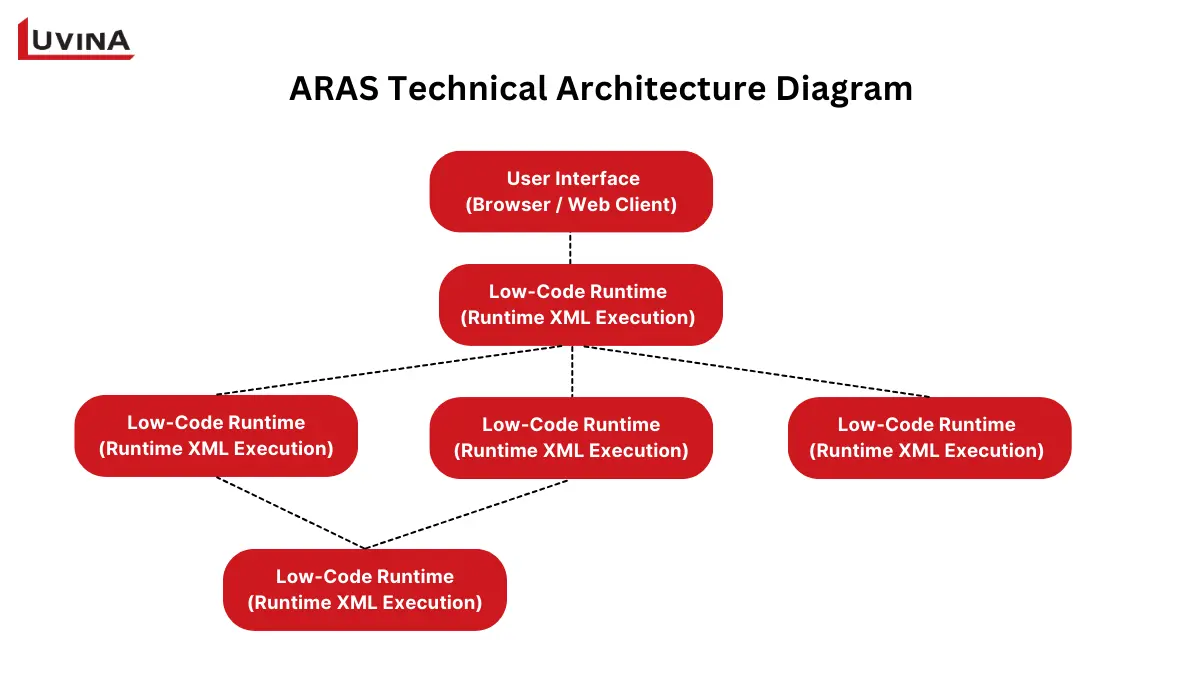
Model-based service-oriented architecture (SOA) and runtime XML
Model-driven SOA using XML metadata to specify business rules, workflows, and data structures is at the heart of Aras PLM. These definitions are read at runtime, therefore enabling prototyping, system setup, and updates without code compiling or linking. Providing the technical underpinnings for the Aras PLM technology, this runtime XML mechanism enables real-time changes and ongoing development of applications.
Deployment architecture and modular service layers
The Aras PLM system supports hosting in multiple ways: Cloud, on-prem, and hybrid. It has Microsoft SQL Server as its RDBMS and uses a clean ORM to provide data integrity and efficient processing. The modular approach of breaking apart core and application services, integration services improves maintainability, scalability, and overall system resilience for large companies operating many complex product lifecycle products.
A major component of Aras PLM, this modularity is why the Aras PLM architecture may change along with corporate needs.
Low-code development and execution flow
Aras PLM technology has a low-code environment, speeding the development and distribution of bespoke applications. The runtime execution flow dynamically interprets XML definitions, therefore doing away with system downtime throughout upgrades and enabling quick deployment of fresh business logic or workflows.
Open integration and API-driven architecture
Integration is a core component of the acid. The ability to connect with various ERP, CAD, MES, IoT, etc., through established APIs and Connectors creates an environment where these systems can interact with one another easily. The API-based architecture provides a digital connection throughout the lifecycle of the product and guarantees that the flow of data between these systems is real-time, accurate, and continues to provide consistent engineering information that is able to be traced back to its source.
These characteristics make the Aras PLM system one of the most comprehensive and highly extensible technology platforms available on the market.
For more technical information about the requirements to deploy Aras Innovator system, you can also visit our article:
Use-Cases & Industry Applications
Understanding what is Aras PLM begins with seeing how it applies across industries to manage complex product lifecycles and drive innovation. Using the Aras PLM full form, businesses can combine design, engineering, production, and service processes while preserving precise and real-time data.
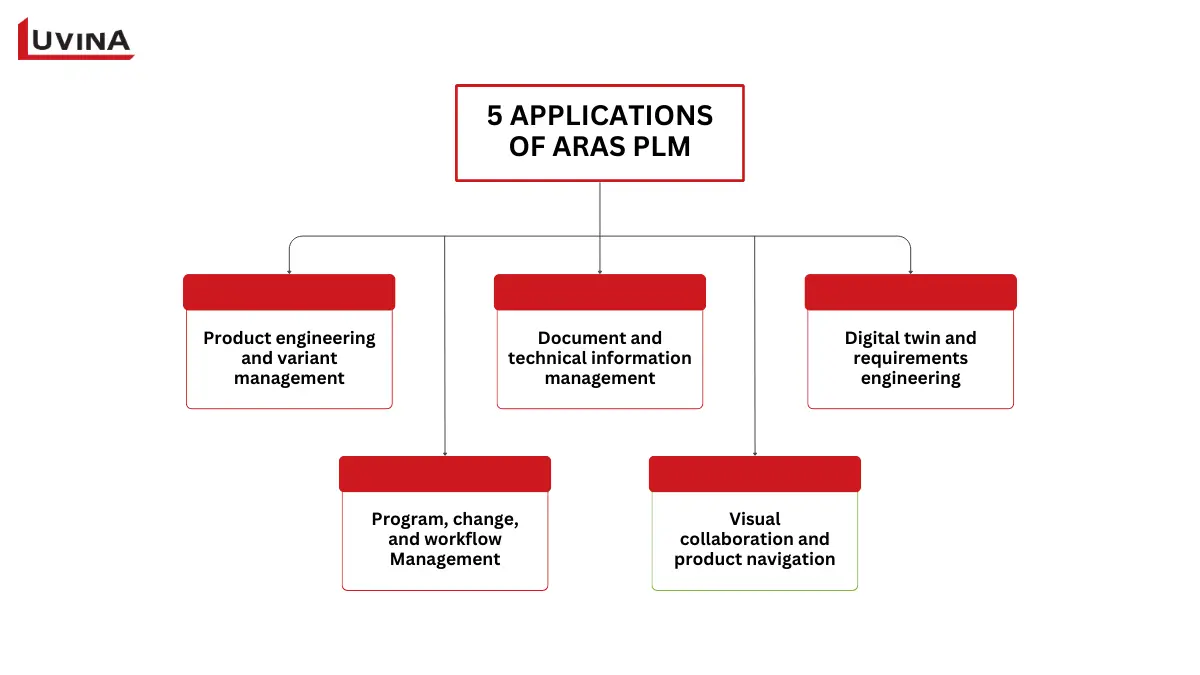
Product engineering and variant management
One of the primary applications of Aras PLM is product engineering, where it provides integrated PLM and PDM capabilities. Organizations can manage parts, multi-level bills of materials (BOMs), configuration management, and change control. Variant Management applications help companies efficiently handle product variants with full traceability and change management, all maintained as part of the overall digital thread managed by the Aras PLM solution.
For instance, Luvina partnered with top Japanese manufacturers in automotive, electronics, and energy to address challenges in material tracking, document management, and machinery maintenance. Using Aras Innovator, Luvina customized BOM, document, and asset management features, reducing material mix-ups, improving version control, and enhancing operational efficiency across multiple facilities. This demonstrates how Aras PLM can be applied to streamline complex, enterprise-wide product lifecycle processes.
Another example of Aras PLM in action is Luvina’s project with a Vietnamese water purifier manufacturer. By applying Aras Innovator, the team centralized all product design versions, streamlined future product upgrades, and reduced documentation and storage workload by 40%.
Document and technical information management
Aras PLM also ensures secure and collaborative management of documents throughout the product lifecycle. The Aras PLM platform provides version control, change tracking, and access management. Teams across locations can access critical information easily, improving collaboration and reducing errors in document handling.
Take a look at a real successful story from Luvina’s client with Aras Innovator in the following case study:
Digital twin and requirements engineering
ARAS PLM software enables organizations to create Digital Twins for any asset and manage requirements in context with the total product configuration. The platform allows predictive maintenance, performance optimization, and requirement traceability, helping companies simulate scenarios accurately and manage product complexity efficiently.
Program, change, and workflow management
Aras PLM is also highly effective in program management and collaborative change management. Project progress can be tracked using stage-gate processes, Gantt charts, and dashboards. Change requests and approvals are systematically captured to ensure traceability, visibility, and consistency.
A practical example of this can be seen in Luvina’s project with a leading Japanese manufacturing company, where workflows for equipment auctions, procurement, and inventory document control were fully digitized. By replacing paper- and Excel-based processes with customized applications on a low-code platform, the client achieved faster approvals, improved data accessibility, and smoother decision-making across departments.
Visual collaboration and product navigation
For complex product designs, Aras PLM provides visual collaboration tools and dynamic product navigation. Users can interact with 3D models, create queries for tailored visualization, and capture design intent directly in context.
Compared to Other PLM Solutions
When considering or evaluating Aras PLM, we must look at how it compares against all other Leading PLM Systems available in the PLM Space. The Aras PLM comparison sets this solution apart from competitors like Teamcenter, Windchill, and Enovia with its combination of open architecture, low-code platform, and scalable infrastructure.
To create the most complete comparison between the Aras PLM solution and its competitors:
| Features | Ars PLM | Teamcenter | Windchill | Enovia |
| Deployment | Cloud, on-premises, hybrid | Cloud, on-premises, hybrid | Cloud-native, SaaS | Cloud-based, Dassault ecosystem |
| Architecture | Open, low-code, model-driven | Monolithic, traditional | Cloud-native, IoT-integrated | Design-centric, CATIA-focused |
| Change and configuration management | Flexible, cross-disciplinary with AI-assisted impact analysis | Strong, manufacturing-focused | Advanced configuration support | Limited at enterprise scale |
| Document and compliance | Integrated, traceable, version-controlled | Integrated, but complex | Good, especially for IoT workflows | Design-focused, less enterprise-wide coverage |
| Digital thread and traceability | Fully integrated across the lifecycle | Partial | Moderate | Limited outside design context |
| Variant management | Branch/merge, cost-effective reuse | Tied to BOM copies | Moderate | Limited scalability |
| Quality and risk management | Native QMS with CAPA, DFMEA/PFMEA | Strong, manufacturing-heavy | Moderate | Weak linkage to engineering artifacts |
| Collaboration and supplier integration | Secure portals, governed APIs, and real-time | Document-centric, limited partner workflows | Moderate | Limited real-time partner collaboration |
| Stimulation and system engineering | Connected to requirements and digital thread | Often manual | Partial | Focused on 3D design visualization |
| Manufacturing process planning | EBOM-MBOM reconciliation, live work instructions | Strong, process-heavy | Limited | Minimal enterprise-wide MPP support |
| Service and digital twins | Digital Twin Core, predictive maintenance | Basic | Partial | Limited service integration |
Comparison table of Aras PLM platform with other PLM software
Aras PLM differentiates itself from its competitors because its open, flexible structure and company-wide adaptability allow it to serve more sectors of industry than other companies that offer only one sector-specific set of tools for product lifecycle management.
Implementation Considerations & System Integration
Effective usage of Aras PLM calls for thorough preparation and knowledge of both the technological and organizational elements of the system. Though the Aras PLM system is really strong and flexible, this also implies that conventional waterfall methods may not be successful.
Organizations should include IT outsourcing and system integration partners in the implementation plan and embrace agile, cooperative approaches to maximize value. Early involvement of cross-functional teams and executives is absolutely vital to fit company objectives with technical deployment and guarantee easy adoption all throughout the company.
Key best practices for implementing Aras PLM include:
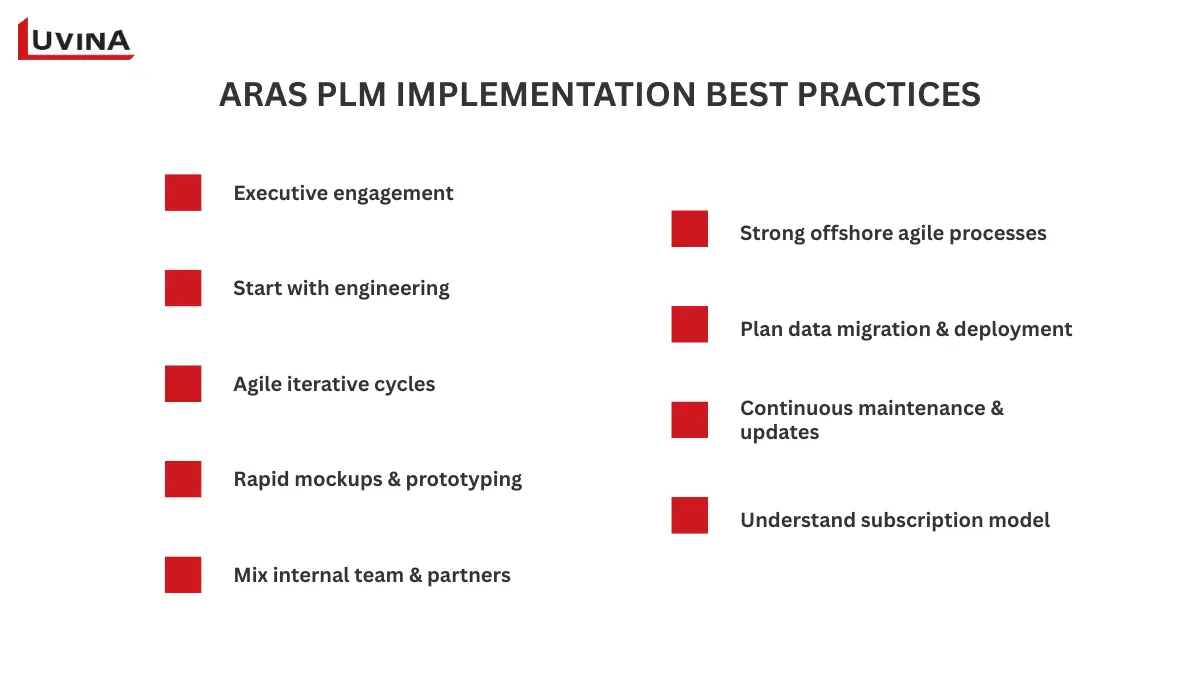
- – Early involvement of executives and sustained involvement throughout deployment will help you to run the program top-down.
- – To guarantee firm-wide adoption, begin with engineering, then branch out to other functional spheres.
- – Adopt agile approaches: Meet, evaluate, mockup, amend, and create in brief, often in cycles.
- – Leverage rapid mockups and prototyping capabilities inherent in the ARAS PLM platform to accelerate validation.
- – Blend internal teams with experienced implementation partners who understand both technology and business processes.
- – When outsourcing or going offshore, ensure strong internal agile processes to maintain efficiency.
- – Plan properly for data migration, deployment, training, and change management to prevent delays.
- – As part of the system lifecycle, get ready for continuous maintenance, assistance, improvement, and release management.
- – Since long-term scalability requires converting from open source to paid subscription, know subscription models and expenses upfront.
Conclusion
In this article, we explored what Aras PLM is. Organizations can make wise decisions to better product lifetime management, boost cooperation, and foster innovation throughout their company by grasping PLM definitions by Aras and the platform’s features.
For companies trying to use the ARAS PLM solution, cooperating with a seasoned implementation partner is vital. As an experienced PLM service provider, Luvina can lead you through a lean, quick beginning, corporate-wide rollout, and total platform adaptation.
Luvina guarantees your Aras PLM trip is seamless, effective, and in line with your corporate objectives by providing services ranging from strategic planning through full implementation assistance.
Use Luvina’s knowledge and Aras PLM solutions right now to take the following step in revolutionizing your product development methods.
Resources
- https://www.linkedin.com/pulse/aras-plm-good-bad-open-source-oleg-shilovitsky/
- https://beyondplm.com/2016/12/24/behind-aras-plm-momentum/
- https://aras.com/en/why-aras/platform-as-a-service
- https://aras.com/en/resources/all/overview-of-the-aras-plm-platform
- https://www.g2.com/products/aras-innovator/reviews#product-header
- https://www.linkedin.com/pulse/what-inside-aras-plm-tech-stack-thoughts-platform-oleg-shilovitsky/
- https://aras.com/en/compare
- https://www.clevr.com/blog/teamcenter-vs-other-plm-tools-top-plm-solutions-compared-2025#teamcenter-vs-other-plm-tools
READY TO START A PROJECT?
Our experts are eager to explore your needs.


Read More From Us?
Sign up for our newsletter
Read More From Us?
Sign up for our newsletter