




IT Managed Service Provider Singapore: How to Choose the Right Partner


Recurring server issues, unclear ownership once a ticket moves past the help desk; an in-house IT team too stretched to plan. These are common signs that ad hoc fixes are no longer enough.
This is where an IT managed service provider in Singapore can become valuable, taking ongoing responsibility for monitoring, maintenance and support rather than only reacting when something breaks. It is also important to distinguish managed IT vs IT outsourcing in the broader sense, since IT outsourcing itself covers a much wider scope of services.
The question, then, is how to evaluate a provider beyond surface-level claims. This guide walks through exactly that.
What Should Managed IT Services Include?
Not every provider defines “managed IT” in the same way, and contract terms vary widely across the market. Before comparing vendors, it helps to see the full range of tasks that typically fall under this umbrella, and which ones tend to sit outside the standard package.
The table below breaks this down into nine core areas, along with how each is usually covered in a Singapore MSP contract.
| Service area | Typical coverage |
| Service desk / help desk | Included |
| Monitoring & alerting | Included |
| Patching & update management | Included |
| Endpoint & identity management | Included, scope varies by device count |
| Network & cloud operations | Included, cloud-native tenants sometimes optional |
| Backup & disaster recovery | Included, retention terms vary |
| Security operations | Optional |
| Vendor management | Included, ongoing coordination with third-party vendors |
| Project / change work | Project-based |
Common scope of IT managed services in Singapore and typical contract coverage
A few of these deserve a closer look. Security operations is one area where scope can vary significantly between providers. Basic monitoring and alerting may be included in a standard package, while dedicated 24/7 SOC coverage may require a separate service tier. Ask specifically what “security operations” means in your contract before assuming it covers everything.
Vendor management and project or change of work also tends to fall outside a standard infrastructure package. Upgrades, system integrations, and larger application changes are commonly billed as separate projects rather than bundled into the recurring fee. This is where application management services come in, handling the ongoing maintenance and enhancement of specific business applications such as SAP, which sits at a different layer from infrastructure operations altogether.
Understanding this distinction early saves buyers from a common frustration: assuming a fixed monthly fee covers every request, only to find certain work billed separately later. A clear scope of conversation upfront, item by item, is the best way to avoid that gap.
Is Fully Outsourced or Co-Managed IT Right for You?
The right model depends largely on what internal capacity already exists. The table below maps three common scenarios to their typical fit.
| Internal IT capacity | Recommended model | Why |
| No in-house IT team | Fully outsourced | The provider owns the entire operation, from help desk to infrastructure, with no internal team to coordinate with |
| Lean internal IT team | Co-managed | The internal team keeps strategic control and handles specialized tasks, while the provider covers day-to-day operations and overflow |
| Dedicated in-house team | Co-managed or targeted support | The team retains most operations, bringing in a provider for specific gaps such as after-hours coverage or specialized tooling |
Matching internal IT capacity to the right delivery model
Neither model is inherently better, each trade off differently:
- Fully outsourced trades internal control for full coverage, ideal when there is no internal team to coordinate with.
- Co-managed IT keeps ownership in-house but requires clearer coordination between two parties.
For a closer look at outsourcing IT: benefits and trade-offs, it’s worth weighing how much strategic input you want to retain versus how much operational load you want to hand off.
One more distinction matters here. Infrastructure management and application managed services are typically two separate categories of service, even though the line between them can blur depending on the provider. Buyers should clarify this upfront rather than assume one automatically covers the other. If your roadmap includes application upgrades, integrations, or custom development, that work usually calls for a dedicated software partner, since infrastructure operations and application delivery draw on different skill sets.
How to Choose an IT Managed Service Provider in Singapore
With the scope and delivery model roughly settled, the real evaluation work begins. The seven areas below cover what separates a genuinely capable provider from one that simply sounds reassuring on a sales call.
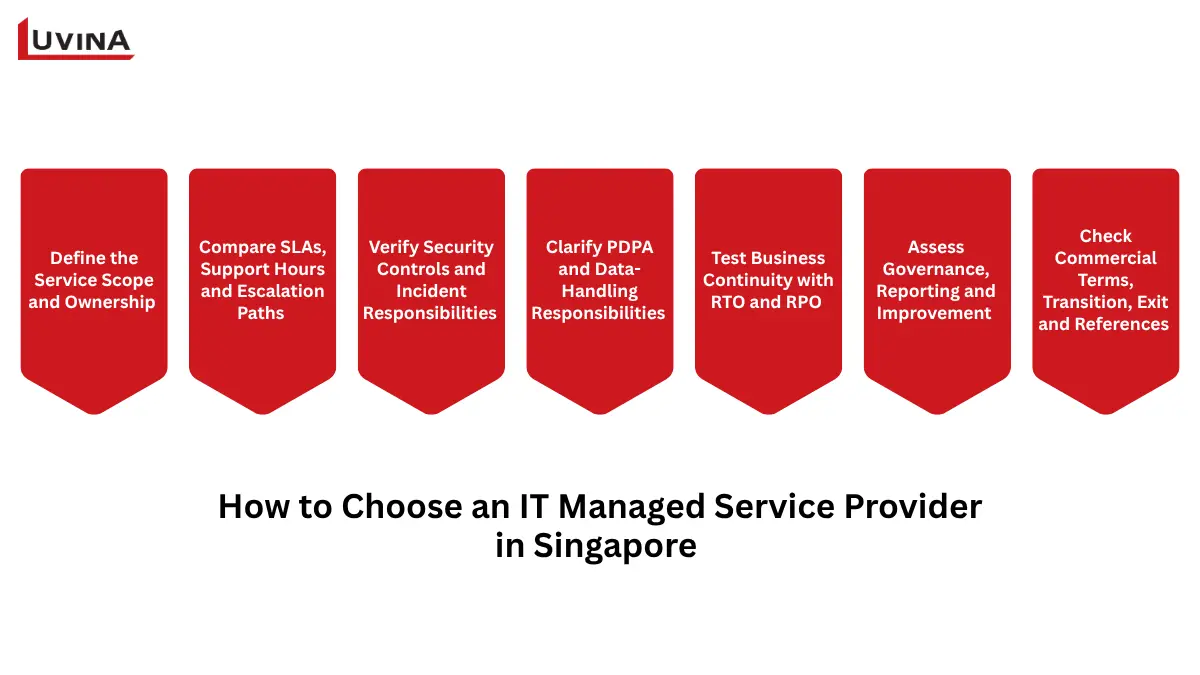
Seven criteria to evaluate before choosing an IT managed service provider in Singapore
Define the Service Scope and Ownership
Before signing anything, get clarity on who owns what: tasks, tools, software licenses, hardware assets, third-party vendor relationships, and any ongoing projects. Ambiguity here is where most disputes start later.
Questions to ask:
- Who is the single point of contact when an issue falls outside the contracted scope?
- Which assets and licenses remain under our ownership versus the provider’s?
Compare SLAs, Support Hours and Escalation Paths
Response and resolution targets should be broken down by severity level, not stated as one blanket figure. A critical outage and a minor request should never share the same commitment window.
Questions to ask:
- What are the response and resolution times for each severity tier?
- What falls under exclusions, and what happens once support hours end?
Verify Security Controls and Incident Responsibilities
Ask specifically how patching is managed, who holds privileged access, and how incidents get reported once detected. It is worth noting that Singapore’s Cyber Security Agency expanded the Cyber Essentials and Cyber Trust marks in April 2025 to cover cloud, AI, and OT security, not just classical network defense. Look for IT security services that are transparent about which controls are actually in place, rather than a generic assurance.
Questions to ask:
- Who is responsible for patching, and on what cycle?
- How is privileged access managed and audited?
Clarify PDPA and Data-Handling Responsibilities
When a provider processes personal data on your behalf, they typically act as a data intermediary under Singapore’s PDPA. Both parties carry obligations: your organization remains accountable for most PDPA requirements, while the provider is still directly responsible for protection and retention obligations on the data it handles. This section is not legal advice, so consult a qualified advisor for specifics.
Questions to ask:
- How does the provider handle the personal data they process on our behalf?
- What data-handling safeguards are documented in the contract?
Test Business Continuity with RTO and RPO
Recovery time and recovery point objectives should be defined per application based on actual business impact, not applied as a single number across every system.
Questions to ask:
- What are the RTO and RPO for our most critical applications?
- Can the provider show evidence of a recent backup restore test?
Assess Governance, Reporting and Improvement
Ongoing visibility matters as much as day-to-day support. Ask for regular service reviews, ticket and risk reporting, a defined change process, and clear ownership of continuous improvement.
Questions to ask:
- How often are service reviews conducted, and what do reports cover?
- Who owns the improvement roadmap once the contract is running?
Check Commercial Terms, Transition, Exit and References
Pricing structures vary widely, so understand what drives cost before comparing quotes. Also confirm onboarding, documentation handover, and who owns tools and assets if the contract ends.
Questions to ask:
- What are the exit terms, and how is data or documentation returned?
- Can the provider share references from businesses of similar sizes?
How Should You Compare MSP Size and Delivery Models?
Scope and evaluation criteria matter more than size, but the type of provider still shapes how well they fit into a given business. Two dimensions are worth separating: how big the provider is, and where their delivery team is actually based.
Large, Regional or Local MSP: Compare Operating Fit
There is no universal “best” size, only different trade-offs depending on what your business needs:
- Presence and onsite capability: local providers can typically be onsite faster; large regional players may have limited local footprint.
- Specialist depth: larger MSPs often bring broader technical bench strength across more domains.
- Stakeholder access: smaller or local providers usually offer more direct access to decisionmakers
- Commercial flexibility: local providers tend to negotiate terms more flexibly than large, standardized vendors.
Onshore, Offshore or Nearshore MSP: Compare Delivery Fit
Where the delivery team sits changes several practical factors, not just cost.
| Criteria | Onshore (Singapore) | Offshore (remote) | Nearshore (regional) |
| Total cost | Highest | Lowest | Moderate |
| Time zone overlap | Full | Often minimal | Close, typically 1 to 2 hours |
| Language & context familiarity | Strongest | Variable | Generally strong within the region |
| Response speed | Fastest for onsite needs | Slower for physical issues | Comparable for remote work |
| Onsite capability | Native | Limited or none | Depends on arrangement |
| Data access & escalation | Most straightforward | Requires clear cross-border controls | Requires clear cross-border controls |
Comparing onshore, offshore, and nearshore delivery models for Singapore businesses
No single model is superior. An onshore team offers the fastest onsite response but at a premium, offshore delivery lowers cost but demands stronger governance, and nearshore sits between the two.
When a Singapore-Facing, Vietnam-Based Team May Fit
For businesses open to a nearshore arrangement, a Singapore-facing team with delivery capacity in Vietnam can offer a practical middle ground: a local commercial point of contact paired with engineering capacity just one hour away in time zone, often at a lower blended cost than a fully Singapore-based team.
This fit only holds up when a few things are verified upfront:
- Evidence of relevant technical expertise on the Vietnam-based team
- A clear breakdown of responsibilities between the Singapore and Vietnam sides
- Defined support coverage and the actual data path involved
- Cross-border access controls and an escalation RACI that names who owns each step
Without these confirmed, “nearshore” is just a claim, not a working model.
Use a Shortlist Template to Compare Providers
With the criteria from the previous section in hand, the easiest way to compare providers side by side is a simple scorecard. Turn each of the seven areas into a tick-box item, and score every shortlisted provider against the same list:
- Service scope and ownership clearly defined
- SLA response and resolution times by severity
- Security controls and incident responsibilities verified
- PDPA and data-handling responsibilities clarified
- RTO and RPO tested with evidence
- Governance, reporting, and improvement process in place
- Commercial terms, exit, and references confirmed
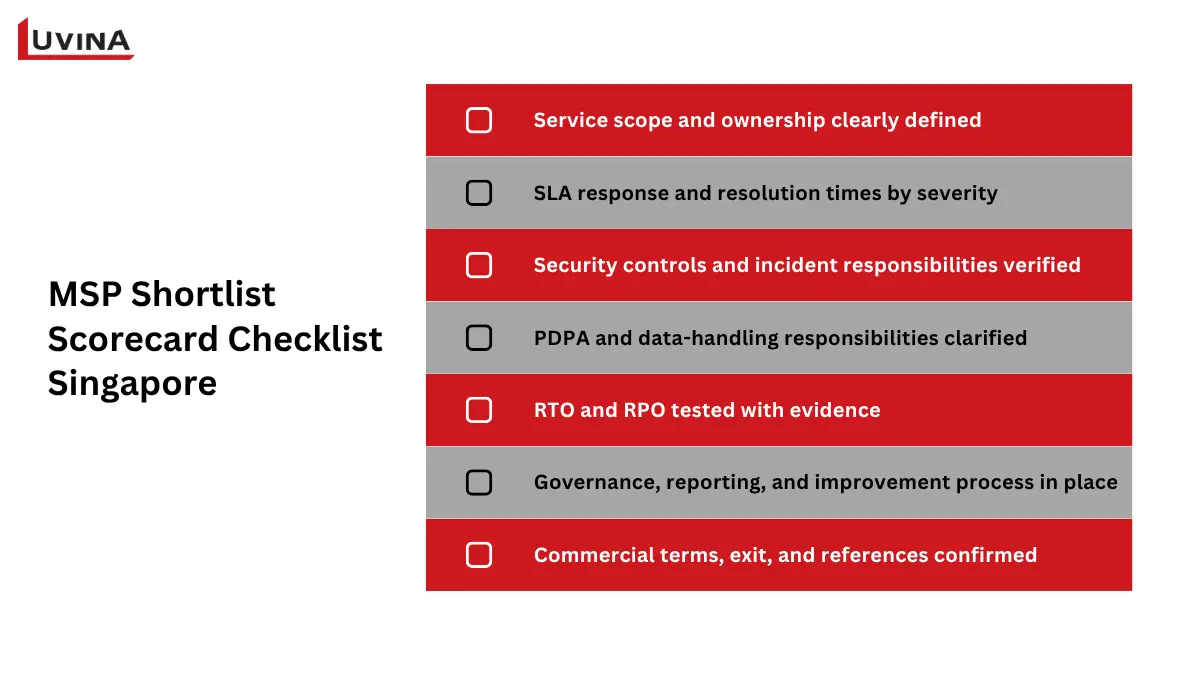
A quick checklist for shortlisting IT managed service providers in Singapore
Beyond the checklist itself, ask each provider to back up their claims with actual proof rather than a sales pitch. A short proof-request list helps:
- Relevant certifications, such as Cyber Essentials or Cyber Trust
- A sample SLA report from an existing client
- At least two references from businesses of similar size or industry
Scoring providers this way keeps the comparison objective and makes it far easier to spot which vendor is genuinely prepared, versus one that is simply confident on paper.
When Managed IT Needs Software Delivery Support
Infrastructure management and application delivery are typically two separate categories of work, even when a single provider can offers both. Keeping servers, networks, and backups running smoothly is not the same as maintaining, integrating, or modernizing the software that runs on top of that infrastructure.
This is where software maintenance services come in, covering ongoing application upkeep, integration between systems, and modernization work that many infrastructure-focused engagements do not include.
Luvina works specifically in this software layer, supporting maintenance, integration, and modernization for enterprise applications. For a Singapore-based retail client, this meant taking over helpdesk and system maintenance for an e-commerce and ERP setup, cutting support costs by half while completing the vendor transition in five days with zero downtime. This is not a claim to full managed infrastructure services, round-the-clock NOC or SOC coverage, or any security certification unless explicitly confirmed for the engagement in question.
FAQs
1. What Does an IT Managed Service Provider Do?
An MSP takes ongoing responsibility for a business’s IT operations, including monitoring, maintenance, support, and security, rather than only responding when something breaks. It shifts IT from reactive fixes to a continuous, accountable service.
2. What Should Managed IT Services Include in Singapore?
Core coverage typically includes service desk support, monitoring, patching, endpoint management, network and cloud operations, and backup and disaster recovery. Security operations and project work often sit outside the standard package.
3. How much do managed IT services cost in Singapore?
Pricing depends on scope, business size, and service tier, so there is no single benchmark figure. Common models include per-user, per-device, or flat monthly fees. Request a quote based on your actual environment rather than relying on published price ranges, which vary widely between providers.
4. How Do I Compare MSP Service Level Agreements?
Compare response and resolution times by severity level, not one blanket figure. Check support hours, exclusions, and escalation paths. A strong SLA spells out consequences when targets are missed.
5. How Do PDPA Responsibilities Work When an MSP Handles Personal Data?
A provider for processing personal data on a business’s behalf generally acts as a data intermediary under PDPA. Compliance responsibility still rests with the business. This is general guidance, not legal advice.
6. Should I Choose an Onshore, Offshore or Nearshore MSP?
Onshore offers the fastest onsite response at a premium. Offshore lowers costs but needs stronger data governance. Nearshore often balances both, closing much of the time zone gap.
Conclusion
Choosing the right provider comes down to scope, accountability, and evidence, not marketing claims. Once you know what to ask and what proof to request, the comparison becomes far more straightforward.
If your evaluation includes application maintenance, integration, or modernization alongside infrastructure needs, talk to Luvina’s Singapore team about your current environment, operating model, critical applications, and outstanding change backlog.
READY TO START A PROJECT?
Our experts are eager to explore your needs.

Read More From Us?
Sign up for our newsletter
Read More From Us?
Sign up for our newsletter