




How to Choose a PLM System Provider in Singapore


Choosing a PLM system provider in Singapore is about more than selecting software or comparing feature lists. The right provider should demonstrate proven platform expertise, strong integration and data migration capabilities, and a delivery and support model that fits your manufacturing environment. Before selecting a partner, assess these capabilities against your requirements, architecture, implementation of risks, and long-term operating needs.
A strong provider should bring three capabilities together: proven platform expertise, reliable integration and migration experience, and a support model aligned with the buyer’s locations, industry requirements, and long-term operating needs.
This guide covers how to evaluate providers, assess platform fit, validate delivery capabilities, and choose a partner that can support your PLM journey beyond go-live.
What Does a PLM System Provider Do?
A PLM provider in Singapore helps manufacturers manage product data and processes across the full lifecycle, from concept and engineering through production, service, and end of life. However, the role extends well beyond supplying a software license. A capable product lifecycle management provider connects business requirements with technology, data, and operational processes, so the solution can work effectively within the existing manufacturing environment.
Scope of work: From discovery to ongoing support
A typical engagement starts with discovery workshops to understand current workflows, pain points, systems, and business goals. The provider then translates these findings into process designs and a PLM architecture. Depending on the selected platform, the scope may include configuration or customization, CAD and enterprise system integration, legacy data migration, testing, user training, and live support.
After deployment, PLM consulting may continue through application support, performance monitoring, release management, issue resolution, and continuous improvement. This ongoing involvement helps ensure the system remains aligned with evolving products and business processes.
Software vendor vs reseller vs systems integrator vs engineering/AMS partner
These roles can overlap, but their responsibilities are different:
| Partner type | Primary responsibility |
| Software vendor | Owns the PLM platform, product roadmap, decide licensing model, and core technical support |
| Reseller | Provides licenses, commercial coordination, and sometimes basic services |
| Systems integrator | Designs and delivers implementation, integrations, migration, and deployment |
| Engineering/AMS partner | Supports custom engineering, application maintenance, enhancements, and long-term operations |
PLM Provider Roles and Responsibilities
Gaps often appear when no single party has an overall outcome. Buyers should therefore appoint one accountable delivery partner to lead or establish a clearly documented multi-vendor RACI covering implementation, data, integrations, support, and escalation.
When should a Singapore Manufacturer Engage a PLM Provider?
The need for PLM solutions in Singapore is not determined by company size alone. A manufacturer may benefit from external expertise when product complexity, data volume, or operational dependencies become difficult to manage with existing tools and internal resources. Several signals can indicate that it is time to consider a dedicated manufacturing PLM partner.
You may need support if:
- Engineering teams work with conflicting CAD files, document versions, or duplicate product records.
- BOM structures are difficult to control, while ECR and ECO approvals still rely on email or spreadsheets.
- Growing product complexity, regulatory requirements, multi-site development, or supplier collaboration makes traceability harder to maintain.
- Legacy PDM or PLM customizations are making upgrades costly, while teams manually duplicate information across PLM, ERP, and MES.
- Internal teams lack the capacity or specialized skills required for data migration, system integration, platform engineering, testing, and user adoption.
These challenges often indicate a broader product data management issue rather than a simple software gap. Engaging a provider early can help manufacturers assess the current environment, prioritize use cases, and build a practical roadmap before fragmented processes become harder and more expensive to change.
Define Your PLM Requirements Before Contacting Providers
Before approaching a provider, establish what your PLM initiative needs to achieve. This prevents feature-driven demos and gives procurement, engineering, and IT teams a consistent basis for comparing proposals.
PLM Requirements Checklist
| Requirement | What to prepare |
| Business goals | Define target outcomes and baseline KPIs, such as engineering change cycle time, data search time, or release accuracy. |
| Use cases & data | Prioritize key workflows and identify required data, including BOMs, documents, requirements, variants, and quality records. |
| System landscape | Map CAD, ERP, MES, CRM, quality, identity, and analytics systems that PLM must connect with. |
| Migration needs | Assess legacy data volume, quality, ownership, mapping, cleansing, validation, and migration waves. |
| Non-functional requirements | Define expectations for performance, security, availability, recovery, auditability, user volumes, and support windows. |
PLM Requirements Checklist
1. Define business outcomes and baseline KPIs
Start with the problems you want to improve and record the current baseline. Depending on your processes, relevant measures may include:
- Engineering change cycle time
- Product data search and reuse time
- Release accuracy
- Rework frequency
- Audit preparation effort
There is no universal KPI target. Your baseline should reflect your current processes, product complexity, and business priorities.
2. Map use cases and data scope
Define which processes and information the solution must support:
- Documents, parts, and product specifications
- EBOM, MBOM, and Service BOM
- Requirements and quality records
- Product variants and configurations
- Supplier and collaboration data
- BOM management and change management workflows
This gives providers a clear view of the functionality and PLM data migration scope they need to address.
3. Document your existing technology landscape
Map the systems that PLM must work with, including:
- CAD and engineering tools
- ERP and MES
- CRM and quality systems
- Identity and access management
- Analytics and data platforms
- Data residency or deployment constraints
This step is essential for assessing PLM integration complexity before proposals are developed.
4. Set non-functional requirements
Define expectations for performance, user and site volumes, security, auditability, availability, recovery, and support windows. For Aras environments, review the Aras PLM deployment requirements when assessing infrastructure and topology constraints.
A clear requirements baseline makes provider responses easier to compare and helps ensure the selected solution addresses your actual operating environment, rather than simply matching a feature checklist.
How to Choose a PLM System Provider in Singapore
Choosing a PLM implementation partner should go beyond checking certifications, partner badges, or years in business. A provider may have strong platform credentials but lack the delivery experience needed for your specific product data, integrations, migration complexity, or operating model.
A practical way to compare shortlisted providers is to use a weighted evaluation framework:
PLM provider evaluation scorecard
Use the same 100-point framework for every shortlisted provider. Score each provider based on evidence rather than marketing claims, certifications or partner badges.
| Evaluation area | Weight | What to assess |
| Platform expertise | 20 points | Relevant certifications, platform experience, configuration and customization capability |
| Implementation capability | 20 points | Delivery methodology, project governance, testing, training, and go-live experience |
| Integration and migration | 20 points | CAD, ERP, MES integration, legacy data migration, cleansing, validation, and cutover |
| Industry and local fit | 15 points | Relevant manufacturing experience, Singapore stakeholder access, and regional delivery capacity |
| Support and operations | 15 points | SLA coverage, escalation model, AMS capability, release management, and post-go-live support |
| Commercial and long-term value | 10 points | Scope clarity, assumptions, customization strategy, upgradeability, and total cost of ownership |
| Total | 100 points |
The score alone should not determine the final decision. Use it to structure evidence-based discussions and identify gaps between providers.
Look beyond partner badges
A partner badge confirms a relationship with a platform vendor, but it does not prove that the proposed team can deliver your specific programmer. Ask for named delivery roles, relevant project references, architecture diagrams, migration plans, integration approaches, and clear support commitments.
For specialist requirements, review the provider’s actual service capabilities, such as Aras PLM consultant services, rather than relying solely on a certification or partner status.
Test expertise with a real scenario
A generic product demonstration rarely reveals how a provider will handle your environment. Instead, give each shortlisted team one representative scenario involving a BOM structure, an engineering change, and an integration with an existing enterprise system.
Ask them to explain:
- How the BOM would be structured and governed
- How the change workflow would be configured
- How data would move between connected systems
- What would be standard configuration versus custom development
- How testing and validation would be handled
This approach exposes practical delivery capability much faster than a feature walkthrough.
Assess the platform for long-term ownership
Your evaluation should also examine what happens after implementation. Compare each provider’s approach to customization, technical debt, upgrades, release compatibility, and application ownership.
A strong PLM system integrator in Singapore should explain what can be configured, what requires custom code, how those decisions affect future releases, and who will maintain the solution over time. The goal is to select a team that can create sustainable lifecycle value, rather than simply deliver a successful go live.
A Six-Step PLM Provider Selection and Implementation Process
Selecting a provider is only one part of a successful PLM implementation in Singapore. The process should connect business requirements with technical validation, delivery planning, and user adoption. A structured approach also helps buyers identify risks before committing to a platform or implementation model.
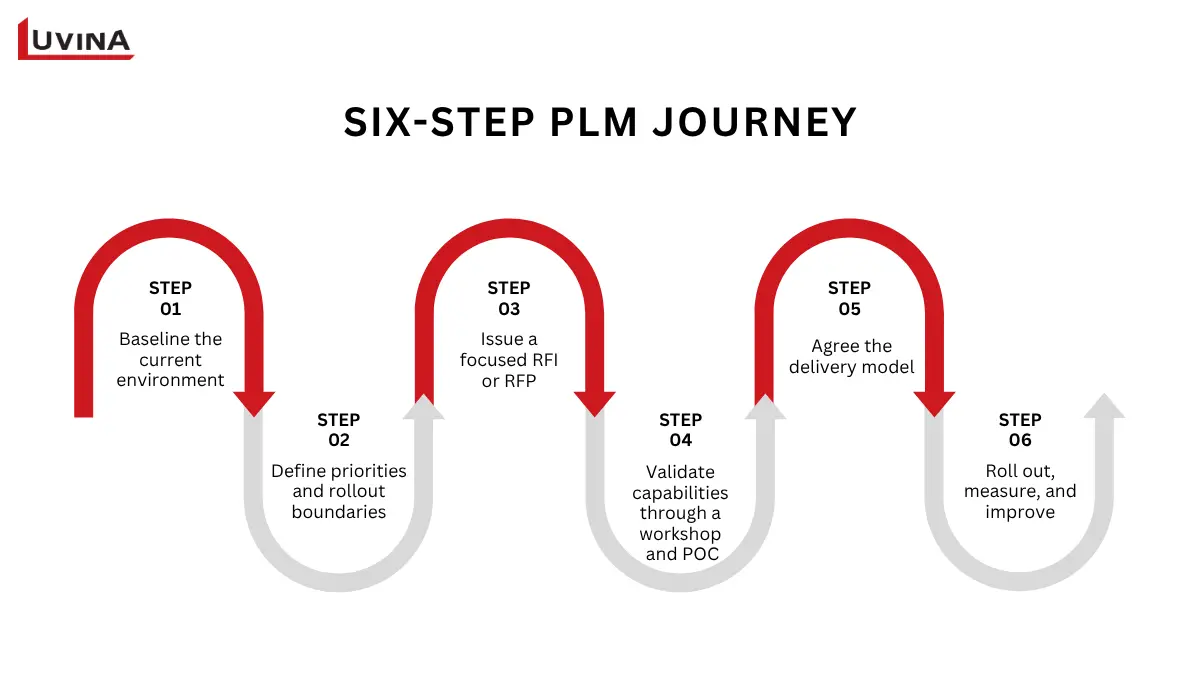
6 Step PLM Provider Selection & Implementation
Step 1: Baseline the current environment
Document existing processes, systems, pain points, and measurable outcomes. Map how product data moves between engineering, manufacturing, quality, and other functions. This baseline provides the reference point for defining requirements and assessing potential improvements.
Step 2: Define priorities and rollout boundaries
Prioritize the use cases that will deliver the most business value. Establish the required product data scope, integrations, user groups, sites, and initial rollout boundaries. A focused scope makes provider proposals easier to compare and reduces unnecessary complexity during the first phase.
Step 3: Issue a focused RFI or RFP
Prepare an RFI or RFP around defined requirements rather than a generic feature list. Set mandatory evidence gates for platform expertise, relevant references, migration capability, integration experience, delivery roles, and support capacity. Shortlist providers that can demonstrate evidence against these criteria.
Step 4: Validate capabilities through a workshop and POC
Use a practical PLM proof of concept to test how shortlisted teams handle representative data and workflows. A useful scenario could include a BOM structure, engineering change, and integration with an existing CAD, ERP, or MES environment. Evaluate the proposed approach, assumptions, technical decisions, and validation method.
Step 5: Agree the delivery model
Before signing, align the target architecture, migration strategy, RACI, milestones, acceptance criteria, risks, commercial assumptions, and support model. Clearly define ownership across the provider, internal teams, software vendor, and other third parties.
Step 6: Roll out, measure, and improve
Deploy the solution in manageable phases and provide role-based training before each rollout. After go-live, track adoption and business KPIs, review operational issues, and maintain an improvement backlog.
There is no universal timeline for a PLM rollout. Project duration depends on scope, data quality, integration complexity, validation requirements, and organizational readiness. A realistic plan should reflect these factors rather than rely on a fixed implementation period.
Singapore-Specific Considerations
Choosing a PLM solution in Singapore requires attention to the local manufacturing environment, regional operations, and technology governance. The right considerations will vary by industry and operating model, so buyers should focus on factors that directly affect their products, sites, suppliers, and data.
Match the provider to your manufacturing environment
Industries such as precision engineering, semiconductor equipment, electronics, aerospace and MRO, and medtech often manage complex products, strict quality requirements, and extensive supplier networks. A provider with relevant sector experience can better understand these workflows and support broader Singapore manufacturing digitalization initiatives. For additional context, see Luvina’s guide to digital transformation in manufacturing.
Plan for local and regional collaboration
If operations extend across ASEAN, assess whether the provider can support Singapore stakeholders while coordinating delivery across regional teams. Consider:
- Local access for workshops, decision-making, and critical support
- Collaboration with suppliers and manufacturing sites across ASEAN
- Support hours, escalation paths, and regional service coverage
- Consistent governance across multiple locations
Address security and data governance early
The deployment model should reflect your security and operational requirements. Evaluate cloud versus on-premises options alongside identity management, access controls, cybersecurity, backup, disaster recovery, and data residency.
Singapore’s PDPA applies to personal data, so it should not be treated as a blanket regulation covering all engineering or product information. Intellectual property, technical data, access permissions, and contractual confidentiality require separate controls.
If grants or digitalization support form part of the business case, confirm current eligibility and conditions directly with Enterprise Singapore before procurement. Do not assume that a PLM project automatically qualifies for funding.
How Platform Fit Affects Provider Choice
Platform selection and provider selection are closely connected. Before comparing implementation teams, assess how well the PLM platform fits your existing technology landscape and long-term operating model.
What to assess before selecting a platform
Consider these factors first:
| Evaluation factor | Key question |
| Existing ecosystem | Does the platform work effectively with your CAD, ERP, MES, and other core systems? |
| Product complexity | Can it manage your BOM structures, configurations, engineering changes, and product variants? |
| Deployment model | Does cloud, on-premises, or hybrid deployment fit your security and operational requirements? |
| Extensibility | Can the solution be configured and extended without creating excessive technical debt? |
| Integration | Can it support the required data flows and interfaces across your enterprise architecture? |
| Release strategy | How will customizations and integrations remain compatible with future releases? |
| Total cost of ownership | What will implementation, licensing, infrastructure, upgrades, and ongoing support cost over time? |
Key Factors for Evaluating PLM Platform Fit
Common PLM platforms
Manufacturers may evaluate platforms such as Windchill, Teamcenter, ENOVIA/3DEXPERIENCE, SAP PLM, and Aras Innovator. These are common options, not universal rankings. The right choice depends on your business requirements, existing systems, and future roadmap. A deeper understanding of Aras PLM can also help buyers assess whether its capabilities align with their requirements.
Match the provider to the selected platform
Once a platform is shortlisted, verify that the provider has proven experience across the wider architecture, not just the PLM application itself. Ask for evidence of:
- Platform implementation and configuration experience
- CAD, ERP, and MES integration capability
- Data migration and validation expertise
- Customization and upgrade management
- Long-term application support
A provider with deep expertise in your chosen platform and enterprise environment is more valuable than one with a broad but shallow platform portfolio. The wider role of PLM in manufacturing, including common capabilities and use cases, is covered in PLM software for manufacturing.
What a Strong PLM Proposal and Engagement Plan Should Include
A strong PLM proposal should give procurement, engineering, and IT teams enough detail to understand what will be delivered, who owns each activity, and what the engagement will cost over time. A proposal that focuses mainly on features or licensing can leave important delivery risks unresolved.
Use the following checklist to assess whether the proposed PLM implementation scope is sufficiently complete:
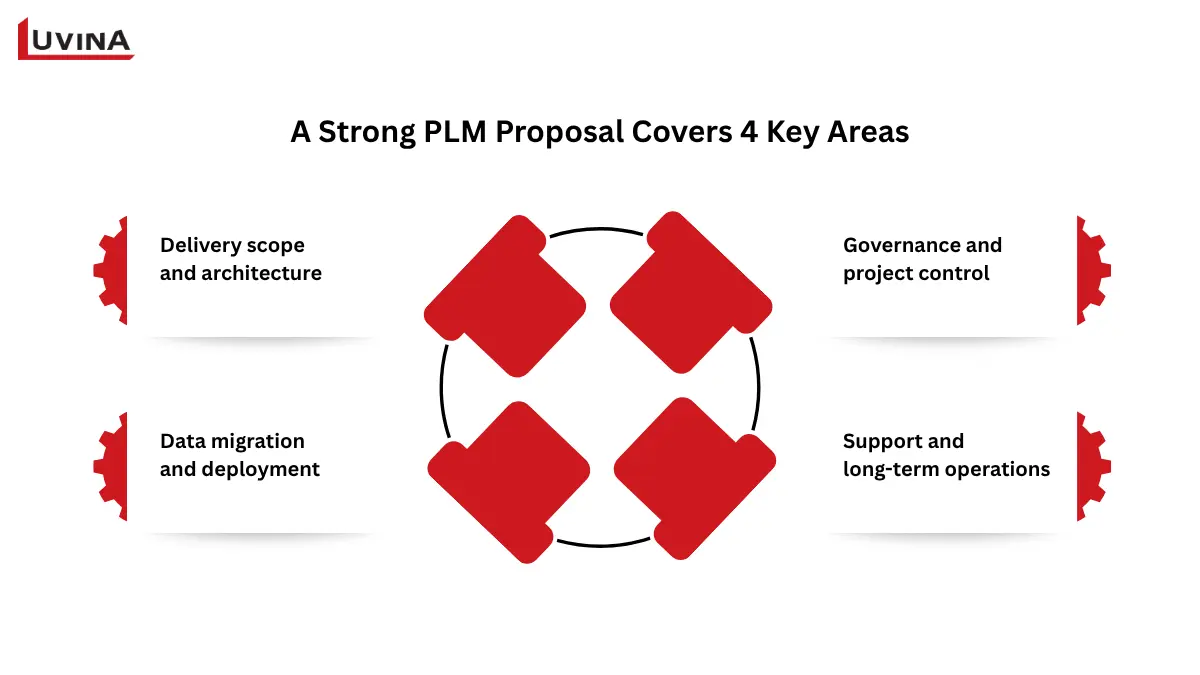
What a Strong PLM Proposal Should Cover
Delivery scope and architecture
- Scope, assumptions, exclusions, and responsibilities
- Target architecture and interface inventory
- Key integrations, environments, and technical dependencies
Data migration and deployment
- Migration waves, data cleansing, mapping, and validation approach
- Cutover and rollback strategy
- Development, testing, staging, and production environment plan
Governance and project control
- RACI covering provider, customer, platform vendor, and other parties
- Milestones, acceptance criteria, risks, and reporting cadence
- Change control process for scope, requirements, and customization
Support and long-term operations
- Role-based training and adoption activities
- Warranty terms and PLM support SLA
- Application maintenance, release management, and escalation procedures
- Three-year cost model covering implementation and ongoing operations
Before signing, make sure assumptions and exclusions are explicit. A detailed engagement plan makes commercial comparisons more meaningful and reduces the risk of unexpected responsibilities, costs, or technical dependencies emerging during implementation.
Why Consider Luvina as a PLM Partner in Singapore?
For manufacturers looking for an Aras PLM partner in Singapore, Luvina brings together local consulting engagement and engineering delivery capacity from Vietnam. Luvina has a Singapore office and is listed as an official Aras partner, providing a foundation for regional consulting and delivery. The official Aras partnership also provides a verifiable reference for this relationship.
Luvina’s PLM implementation services cover key areas across the lifecycle, including:
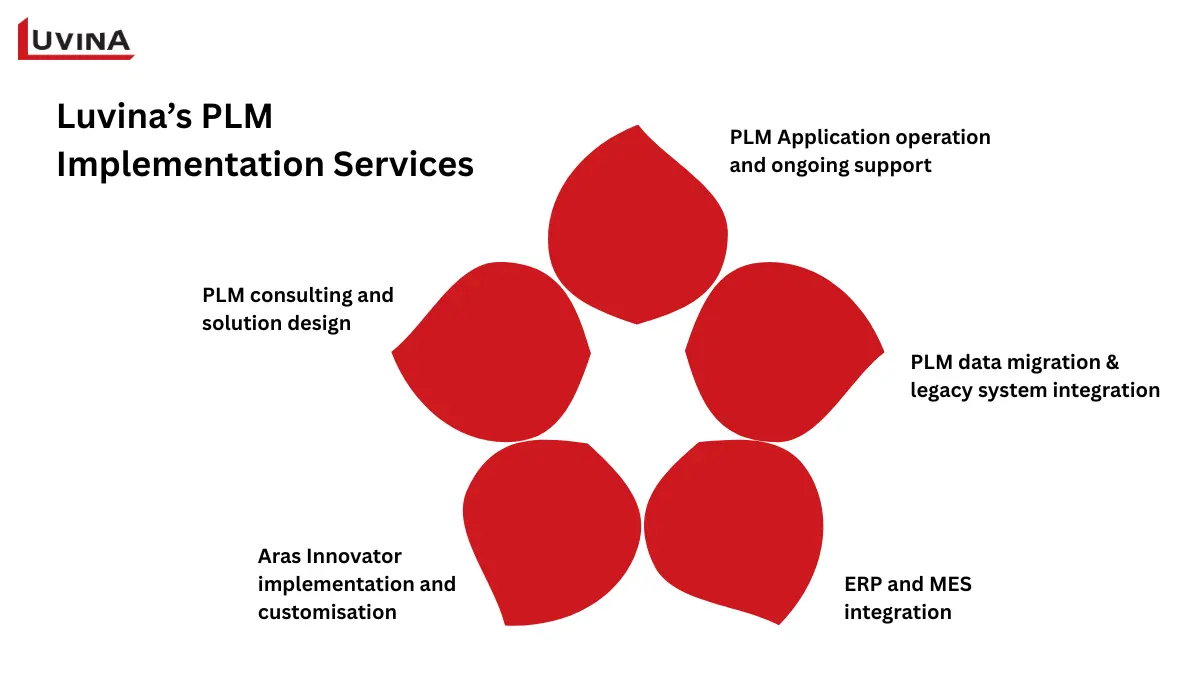
End-to-End PLM Implementation Services by Luvina
- PLM consulting and solution design
- Aras Innovator implementation and customization
- ERP and MES integration
- PLM data migration & legacy system integration
- PLM Application operation and ongoing support
The delivery model combines Singapore-based stakeholder engagement with Vietnam engineering resources. This can support organizations that need local communication while maintaining access to a broader technical team. Luvina’s two decades of experience delivering software for Japanese customers also brings a quality-focused engineering and delivery culture to its PLM engagements.
One example is its BOM and document management solution using Aras Innovator, developed for automotive, electronics, and energy manufacturers through partnerships with leading Japanese SI companies. The engagement addressed structured product information and document control, along with related challenges such as machinery and equipment tracking and facility-level document management across multiple sites.
If you are evaluating Aras PLM for your manufacturing environment, as an Aras partner, Luvina can help assess your current product data, workflows, ERP/MES landscape, and integration requirements to define a practical implementation approach.
FAQs
1. What does a PLM system provider do?
A PLM system provider helps manufacturers plan, implement, and operate a product lifecycle management solution. Its scope can include discovery, process design, platform configuration, integration, data migration, testing, training, go-live support, and ongoing application maintenance.
2. How do I choose a PLM provider in Singapore?
Focus on four areas: platform and architecture fit, proven delivery experience, integration and migration capability, and post-go-live support. Ask for shortlisted providers for relevant project references and proposed delivery roles. You should also review technical artefacts, migration methods, and support commitments. Do not rely solely on certifications or partner status.
3. How much does a PLM implementation cost in Singapore?
There is no standard PLM implementation cost in Singapore. Pricing depends on user and site volumes, required modules, data volume and quality, integrations, customization, and deployment. Testing, validation, training, and ongoing support also affect the total cost. Ask providers for a detailed cost model that separates implementation from recurring expenses.
4. Which PLM platform is best for a Singapore manufacturer?
There is no universally best PLM platform. The right choice depends on your existing CAD and ERP ecosystem, product complexity, integration requirements, deployment preferences, and long-term operating model. Windchill, Teamcenter, ENOVIA/3DEXPERIENCE, SAP’s PLM, and Aras Innovator may suit different manufacturing environments.
5. Can PLM integrate with existing CAD, ERP, and MES systems?
Yes. PLM integration can use standard connectors, APIs, middleware, or custom interfaces. The right approach depends on the systems involved, including how PLM data flows to and from a Manufacturing Execution System (MES) on the shop floor. A provider should define data ownership, interface responsibilities, monitoring, error handling, security, and upgrade compatibility. Integration planning should also cover validation and post-go-live support.
Conclusion
Choosing the right PLM system provider in Singapore means looking beyond a successful go live. Test every shortlisted provider against three questions: Does the solution fit your architecture? Can the team prove its delivery capability? Who will own and support the system after launch?
A clear answer to these questions can help reduce implementation risk and build long-term value from your PLM investment. If you are defining your requirements or comparing delivery options, discuss your PLM requirements with Luvina.
READY TO START A PROJECT?
Our experts are eager to explore your needs.

Read More From Us?
Sign up for our newsletter
Read More From Us?
Sign up for our newsletter