




What Is Product Lifecycle Management? A Business Guide


What is product lifecycle management? It is how a business coordinates decisions about what to develop, launch, improve or retire, using shared product information across teams.
Picture a packaged-food brand whose customers now ask for less sugar while ingredient prices climb. Marketing sees the demand. Finance sees the margin shrinking. Procurement worries about supply, and quality has to sign off on any new recipe. Nobody can answer alone, and a wrong call is expensive.
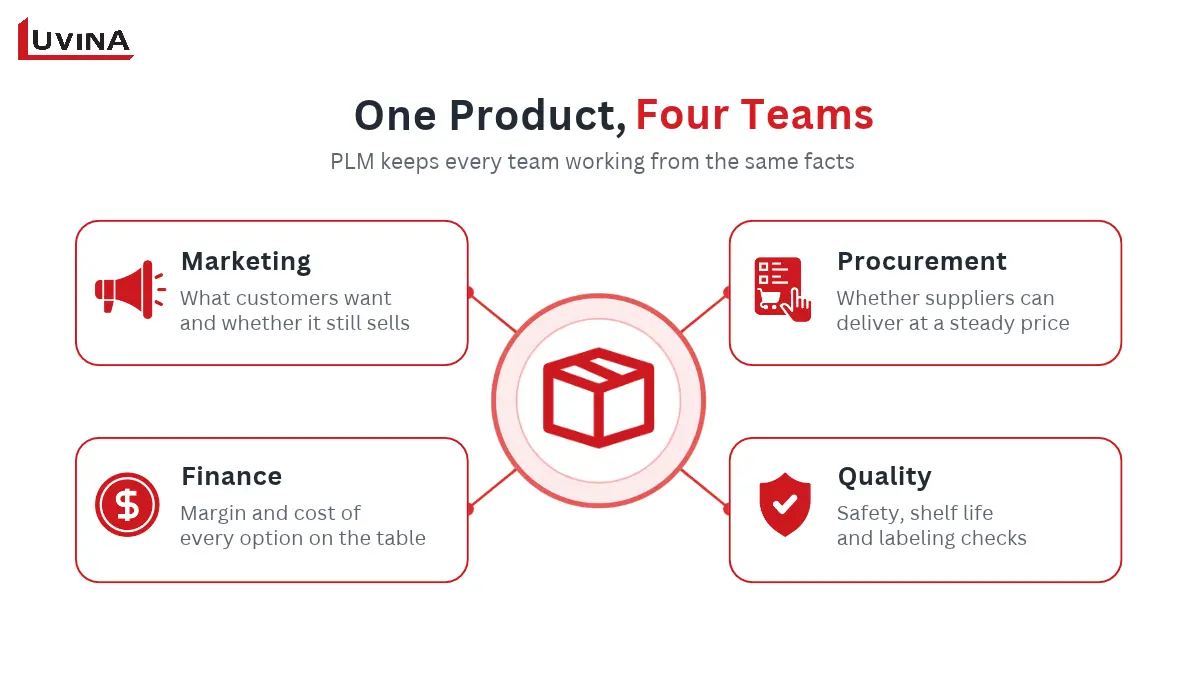
This guide uses that situation to show how such decisions get made, and what a business needs in place before it thinks about software.
What is product lifecycle management?
Product lifecycle management (PLM) is how a business coordinates the decisions, people and information needed to manage a product from its first idea to its eventual withdrawal. It connects the teams that touch a product, so choices about developing, improving or retiring rest on shared facts.
IEEE describes PLM as a discipline that links people, processes and data across a product’s whole life, and Oracle frames it as managing a product from ideation to disposal.
Product decisions rarely sit with one department. Each team holds one slice of the picture, and PLM is what puts the slices together. It does that in three ways:
- One product record: the recipe, specifications and supplier details sit in one place instead of in separate files.
- Approved versions: one version is marked as approved, so every team builds, buys and sells from the same one.
- Change history: each change is logged with its reason and the person who signed it off, so anyone can see what changed, when and why.
In plain terms, it covers six things:
- Customer needs: what buyers want, and whether the product still delivers it.
- Costs: development, sourcing, support, waste and withdrawal, weighed against revenue.
- Requirements: the specifications and rules the product has to meet.
- Quality: how the business checks that every version meets those requirements.
- Responsibilities: who gathers evidence, who decides and who approves.
- Changes: how a new supplier, recipe or feature gets reviewed before it reaches customers.
PLM is a management approach that technology can support, and the software side comes later in this guide.
Why does PLM matter to a business?
A product can look healthy on the sales report and still lose money. PLM matters because it ties each product decision to evidence and to a person who owns it. Three benefits follow from that.
1. Customer value
Teams use customer evidence to decide what the product should be and how to improve it. Support tickets, return reasons and sales feedback all count. If buyers keep asking for less sugar, that signal reaches the people who can act on it instead of sitting in one inbox.
2. Profitability
A product’s cost goes beyond ingredients or parts. Development, sourcing, support, waste, and withdrawal all take a share, and the business has to weigh them against what the product can earn. Finance can often pull cost and supplier data from existing ERP solutions, so the team starts from numbers that already exist. That asks a question like “does this product still earn its place?” answerable.
3. Accountability and risk
When nobody knows who decides, or what evidence is enough, decisions drift. PLM spells out who recommends, who approves and what they need to see first. It also keeps the reasoning behind important calls, so a team can explain months later why it switched against a supplier or dropped a variant.
None of these guarantees better results. It gives the business a way to make each decision deliberately and learn from it.
How does PLM work across a product lifecycle?
This guide splits a product’s life into five stages, but there is no single standard. SAP notes that the phases are described in different ways, so the number, names, and order of stages change with the business and the type of product. A phone and an aircraft, for example, stay on the market for very different lengths of time, as PTC points out. Stages also overlap and loop back, so read the table below as a map.
To see it in action, take an illustrative packaged food brand with a cereal bar line. Customers ask for less sugar, and ingredient costs are rising. The brand and the steps are made up for this guide.
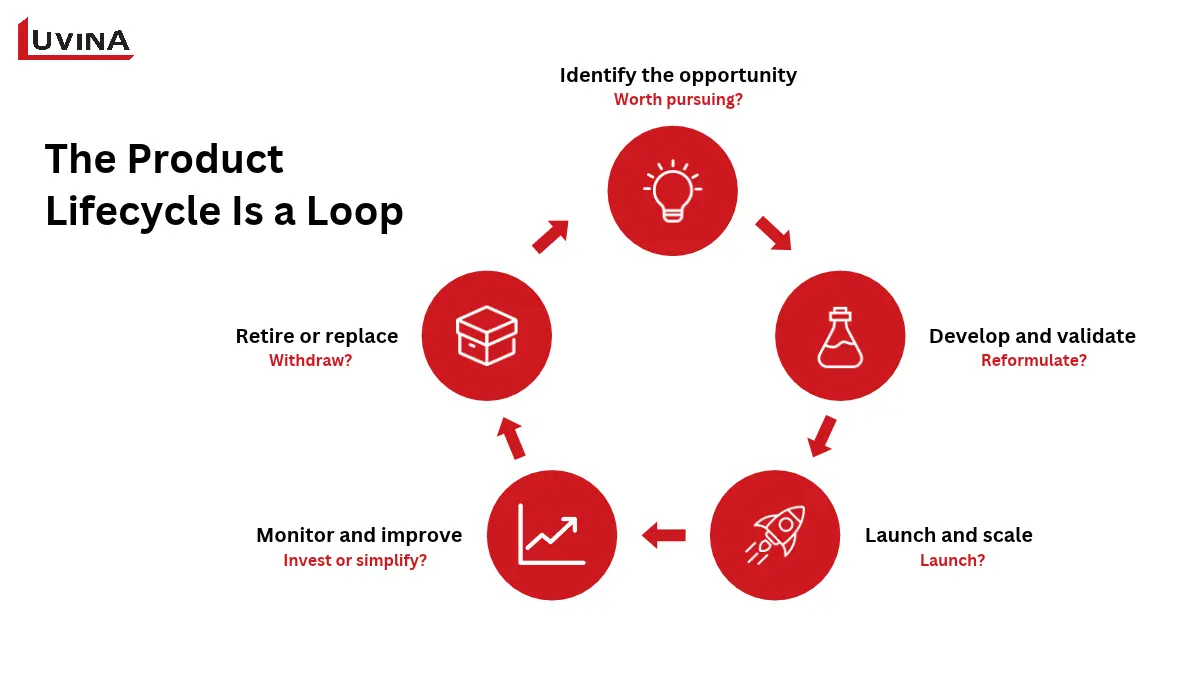
| Stage | Main business question | In the example | Who decides |
| Identify the opportunity | Is there a customer problem worth solving? | Marketing sees growing demand for a lower-sugar bar | Marketing proposes, general manager approves |
| Develop and validate | Can we deliver the right product at an acceptable cost and risk? | The team tests a new recipe for cost, shelf life and labeling | Product, quality, finance |
| Launch and scale | Are the product, supply, channels and support ready? | Suppliers, packaging and retail channels are confirmed | Procurement, sales, operations |
| Monitor and improve | Should we invest, adapt, expand or simplify? | The team tracks sales, complaints and repeat purchases | Marketing, finance |
| Retire or replace | When and how do we withdraw the product responsibly? | The old recipe sells slowly, so it is withdrawn and stock is cleared | General manager, finance, supply chain |
Overview of the five product lifecycle stages
Launch is where many handoffs happen. Launch is where many handoffs happen. The approved recipe, packaging artwork, and supplier details all have to reach purchasing, production and sales in the same version. If one team works from an older file, the wrong label or the wrong ingredient can end up on the shelf. Manufacturers face the same risk on the factory floor, where purchasing, orders and inventory run on their own manufacturing software and have to match the approved product record.
You may also know the commercial model of introduction, growth, maturity and decline. It describes how a product’s market changes over time. PLM covers the work and decisions your teams take along that path. A mature product still needs attention, such as a recipe update or a launch in a new market.
What external factors influence product lifecycle decisions
A product rarely changes because a team feels like it. Something outside the business pushes: a new rule, a rival’s launch, a supplier’s price rise. The useful question is which decision each pressure forces. The table below follows our illustrative cereal bar brand.
| Pressure | Decision it can trigger | Example |
| Legal and regulatory requirements | Change, relabel, delay or withdraw a product | A recipe change alters the allergen statement, so the label must be updated before sale |
| International trade and market access | Enter a market or switch a supplier | The brand wants a new market, but a key ingredient supplier is restricted there |
| Customer expectations and competition | Improve, reprice or reposition | A competitor launches a cheaper lower-sugar bar |
| Technology advances | Upgrade a product or replace an outdated component | New packaging technology extends shelf life |
| Supply and economic conditions | Keep, reprice or drop a product | A key ingredient price rises sharply |
| Environmental expectations | Redesign packaging, reuse or end-of-life handling | A retailer asks for less plastic packaging |
Decision map of six external pressures
Technology pressure also includes everyday tools such as AI. Teams that use them for research or drafting should agree on an AI policy for small business early, before habits settle.
Two regulatory examples show how this plays out. Both were checked on 10 November 2026 and apply only within their own scope.
- EU Digital Product Passport: the European Commission is introducing Digital Product Passport requirements progressively across selected product groups. Certain batteries are among the first products covered, with textiles, aluminum, and tires among the groups expected to follow. Following the adoption of the relevant ESPR delegated act, generally economic operators will have a transition period of at least 18 months to prepare for the applicable requirements. Food products are excluded from the scope of ESPR, although their packaging may be subject to separate requirements under the Packaging and Packaging Waste Regulation (PPWR).
- FDA food traceability: the US rule applies to specified foods on the Food Traceability List and certain foods containing listed ingredients in the same form. The FDA has stated that it will not enforce the rule before 20 July 2028. Food businesses exporting to the US should assess whether their products and activities fall within its scope.
These examples show why businesses need to monitor product-specific and market-specific requirements throughout the product lifecycle. They do not mean that every product requires a Digital Product Passport or specialist PLM software.
How does PLM differ by product type
The lifecycle logic stays the same: an idea, development, sale, improvement, withdrawal. What changes is how much a mistake costs, how fast a product can change and what the business owes customers after the sale. The table summarizes the main business priorities for four product types.
| Product type | Business priorities | Management emphasis |
| Manufactured goods | Reliability, production investment, component availability, service obligations | Validate before committing to production, control changes, plan maintenance and replacement |
| Fashion | Collection timing, assortment, sourcing, fit, seasonal demand | Coordinate collection calendars, samples, variants and supplier decisions |
| Food and beverages | Formulation, ingredient costs, safety, labeling, shelf life, packaging | Review recipe and packaging changes together, validate quality and safety, coordinate traceability |
| Apps and software | Adoption, retention, security, reliability, operating costs | Learn through releases, prioritize improvements, manage support and retirement |
Business priorities by product type
How management methods change
Two methods cover most cases.
- Stage-gate: splits the work into stages, with decision checkpoints, called gates, between them. At each gate, the people responsible review the evidence and decide whether to continue, change direction or stop before more money goes in. A factory orders machinery only after prototypes pass testing, because tooling is hard to undo. A fashion brand locks its collection calendar before ordering fabric for the season. A food brand reviews the recipe, packaging and safety checks before the first production run.
- Iterative approach: improving through repeated cycles of feedback and testing. A software team ships a small release, watches how people use it, then adjusts.
Most businesses combine the two. A food brand can test recipes in small rounds and still keep a fixed checkpoint on safety and labeling before launch. A simple rule helps. The more expensive it is to change course, the more checkpoints a product needs. The cheaper the change, the more cycles it can afford.
Physical products and digital products
Changing an ingredient in a cereal bar reaches well beyond the recipe. Old packaging sits in the warehouse, the production line needs resetting, and some boxes are already on retail shelves.
Software moves differently. A change ships as a release, but it still needs testing, a security review and a plan for customers who must move to the new version.
Application lifecycle management (ALM) covers this software side: governance, development and maintenance of an application. Commercial decisions such as pricing a feature or retiring a product sit above it. Teams that make physical goods often look at PLM software for manufacturing once changes start to affect materials, production and inventory.
Important overlaps
Real products blur these lines. A coffee machine with its own app combines hardware, software and service promises, so the team has to plan firmware updates for years after the sale.
Not every physical product follows a straight line from design to sale, and not every piece of software can change overnight. A seasonal fashion item and a long-lived machine are both physical products, yet one plans in months and the other in decades.
How can a business put PLM into practice
You can start before choosing any software. What you need is a simple process built on four things: a named owner for each decision, data the team can trust, clear criteria for deciding, and follow-up on what was decided. Five steps put those in place.
- Define the objective. Pick one concrete goal, such as improving launch readiness, protecting margin, reducing waste or deciding whether to retire a product.
- Identify the product’s stage and constraints. Gather customer evidence, costs, quality data, supply conditions, applicable requirements and available resources.
- Assign decision owners. Name who gathers the evidence, who recommends, who approves and who monitors the results.
- Agree on evidence and criteria. Decide what the team must know before it proceeds, pauses, changes direction or withdraws. Write down assumptions and open risks.
- Review performance and act. Set a review rhythm, compare results with the objective and agree on the next decision.
Once the routine runs smoothly, this PLM implementation guide shows how to bring it into a system.
A simple business example
Take the illustrative cereal bar brand again. Customers ask for less sugar, and ingredient prices keep climbing. The general manager sets one objective: decide what to do with the current recipe. Each team then brings the evidence it owns.
- Marketing: what are customers asking for?
- Finance: how much margin is left at today’s costs?
- Procurement: can suppliers deliver a new recipe at a steady price?
- Product and quality: does the new recipe hold up on taste, shelf life, safety and labeling?
With that evidence on the table, the general manager compares four options: reformulate, raise the price, reposition the product or withdraw it. The team selects one small trial and sets a date to review the results.
Choose measures that fit the product and objective
Match the measure to the goal. Two or three that inform the decision are enough, and a long dashboard usually hides the answer.
| Business objective | Possible measure |
| Launch readiness | Commercial, supply and quality decisions finished before launch day |
| Protect product economics | Contribution margin (what each sale leaves after variable costs), plus support or withdrawal costs |
| Improve quality and value | Complaints, returns, customer feedback or repeat purchase |
| Reduce waste | Expired, scrapped or unsold stock, where it applies |
| Improve a digital product | Activation, retention or reliability, depending on the goal |
Measures to match each business objective
These are starting suggestions.
When can technology help with product lifecycle management
Technology becomes useful when the process is clear but existing tools can no longer support the level of coordination required. The trigger is usually a coordination problem, not a missing feature. Three coordination problems come up again and again.
| Business problem | Useful supporting capability |
| Teams use conflicting product information | Shared records, clear ownership, approved versions |
| Reviews and approvals stall | Visible responsibilities, decision history, workflow support |
| Teams cannot see product performance | Connected reporting, accessible decision evidence |
Coordination problems matched to supporting capabilities
Many kinds of tools cover part of this ground, so it helps to know what each one does well:
- Document tools: shared drives and spreadsheets. Fine for a simple process with a few products and one team.
- Project tools: track tasks and deadlines but rarely hold the product record itself.
- Enterprise resource planning (ERP): strong on orders, inventory and costs, less on product versions and change reviews.
- Specialist PLM software: keeps product records, versions and change approvals in one place for several teams.
- Software development tools: manage code, releases and testing for apps and digital products.
A document tool can carry a small business a long way. Product lifecycle management software becomes worth the cost when the same questions keep coming back. Which version is current? Who approved this change? Why did we pick up that supplier? When answering these questions requires repeated meetings and manual coordination, a product lifecycle management system may be worth considering.
Manufacturing illustrates how these challenges affect product operations. Since May 2022, Luvina has partnered with Japanese system integrators to support manufacturers in the automotive, electronics and energy sectors. The end users faced practical challenges, including material mix-ups during production, difficulties with document version control and access rights, and gaps in machinery information and maintenance management.
Using Aras Innovator, Luvina customized BOM and document management functions and developed a feature to compare actual materials against planned materials before production. The team also developed proof-of-concept functions for machinery management. According to Luvina’s case study, the solution contributed to a significant decrease in material mix-ups, more accurate document version control, and improved access-rights management.
Before choosing a product lifecycle management solution, check five things:
- Fit with how the business actually works
- Whether teams will use it day to day
- Links to the tools already in place
- How product and supplier data is handled
- Total cost, including setup and training
Pilot one useful process first, such as change approvals for a single product line, then expand. Software supports decision owners and good information habits. It does not replace them.
Some PLM and adjacent tools now offer AI-assisted capabilities. They can speed up search and summaries, but people should check the sources and protect sensitive product data. The NIST AI Risk Management Framework is a voluntary guide to those risks. Smaller teams can begin with AI for small business owners.
FAQs
What is PLM in simple terms?
PLM is how a business manages a product from its first idea to its withdrawal. It keeps development, launch, improvement and retirement decisions connected, so every team works from shared, reliable product information.
Is PLM a business process or software?
It is a management approach backed by business processes. PLM software, such as the platform described in this Aras PLM overview, organizes product information and helps teams coordinate their work. The business still has to set its own objectives, responsibilities and decision rules.
What external factors affect product lifecycle management?
Customer demand, competitors, regulation, trade conditions, supply changes, technology and environmental expectations can all shape a product decision. How much each one matters depends on the product, the market and the business. Legal requirements vary by jurisdiction and product scope, so check the rules that apply to you.
How does PLM differ for physical and software products?
Physical products need attention to materials, production, inventory and after-sales obligations. Software products need ongoing decisions on releases, maintenance and security. Both rely on customer evidence and coordinated decisions. Application lifecycle management (ALM) covers the software delivery side.
Do small businesses need PLM software?
Not necessarily at the start. A small business can apply PLM principles with shared documents and a clear owner for each decision. A specialist tool starts to make sense when products get more complex, more teams get involved, or changes become hard to track. Look at the business problem, how the team will adopt the tool and the total cost first.
Conclusion
Choose one product you manage today. Note which lifecycle stage it is in and what you need from it this quarter. Then name the next big decision, such as reformulating, repricing or retiring it, and the person who owns that call. Put a review date in the calendar.
If your teams are struggling with product data, document control, or cross-functional coordination, contact the Luvina team to assess the technology and integration requirements behind your PLM process.
Resources
- https://single-market-economy.ec.europa.eu/single-market/digital-product-passport_en
- https://www.fda.gov/food/food-safety-modernization-act-fsma/fsma-final-rule-requirements-additional-traceability-records-certain-foods
- https://www.nist.gov/itl/ai-risk-management-framework
- https://technav.ieee.org/topic/product-lifecycle-management/
- https://www.oracle.com/scm/product-lifecycle-management/what-is-plm/
- https://www.sap.com/resources/what-is-product-lifecycle-management
- https://www.ptc.com/en/technologies/plm
- https://learn.microsoft.com/en-us/power-platform/alm/overview-alm
READY TO START A PROJECT?
Our experts are eager to explore your needs.

Read More From Us?
Sign up for our newsletter
Read More From Us?
Sign up for our newsletter