




Types of Software Development: 12 Common Types Explained


If you’ve searched for types of software development, you’ve likely seen very different answers. Some articles list 4 types, while others mention 12 or even more. That’s because they use different ways to classify software development.
The truth is that there is no universal industry standard for the number of software development types. Instead of adding another list, this guide focuses on 12 common types of software development that are most useful for planning a project, building the right team, or evaluating software development services.
You’ll also learn why most modern software projects combine multiple development types and how to choose the right mix for your business needs.
What is Software Development?
Software development is the process of creating software to solve a specific problem or support a business need. It includes planning, designing, coding, testing, deploying, maintaining, and continuously improving the software throughout its lifecycle.
Many people think software development is just writing code, but coding is only one part of the process. A successful project also requires clear requirements, thoughtful design, quality assurance, and ongoing updates to keep the software secure and reliable.
For example, in Luvina’s e-commerce system upgrade project, software development involved more than building new features. The team also modernized the existing system, improved performance, integrated business processes, and continued enhancing the platform to support long-term business growth.
How Many Types of Software Development Are There?
The short answer is that there is no universal number of software development types. Because there is no industry standard, different sources classify software development in different ways. Some group it into a few broad categories, while others list 12, 20, or even more.
A practical way to understand these differences is to look at four common classification perspectives:
- Platform or product domain: Where the software runs or what is being built, such as web, mobile, desktop, embedded, or game development.
- Technical capability: The technical functions involved, such as front end, back end, APIs, data engineering, AI, or cybersecurity.
- Business solution: The business problem the software addresses, including enterprise software, ERP, e-commerce, and custom software.
- Architecture or delivery approach: How the software is designed and delivered, such as cloud native, microservices, DevOps, or low-code platforms.
Different sources often mix these perspectives, which is why their counts vary.
In this guide, we’ll focus on 12 common software development types based on project domains because this level of classification is the most useful for planning projects, defining technical requirements, and choosing the right development partner. While these types are presented separately, most modern software products combine several of them to meet business and technical requirements.
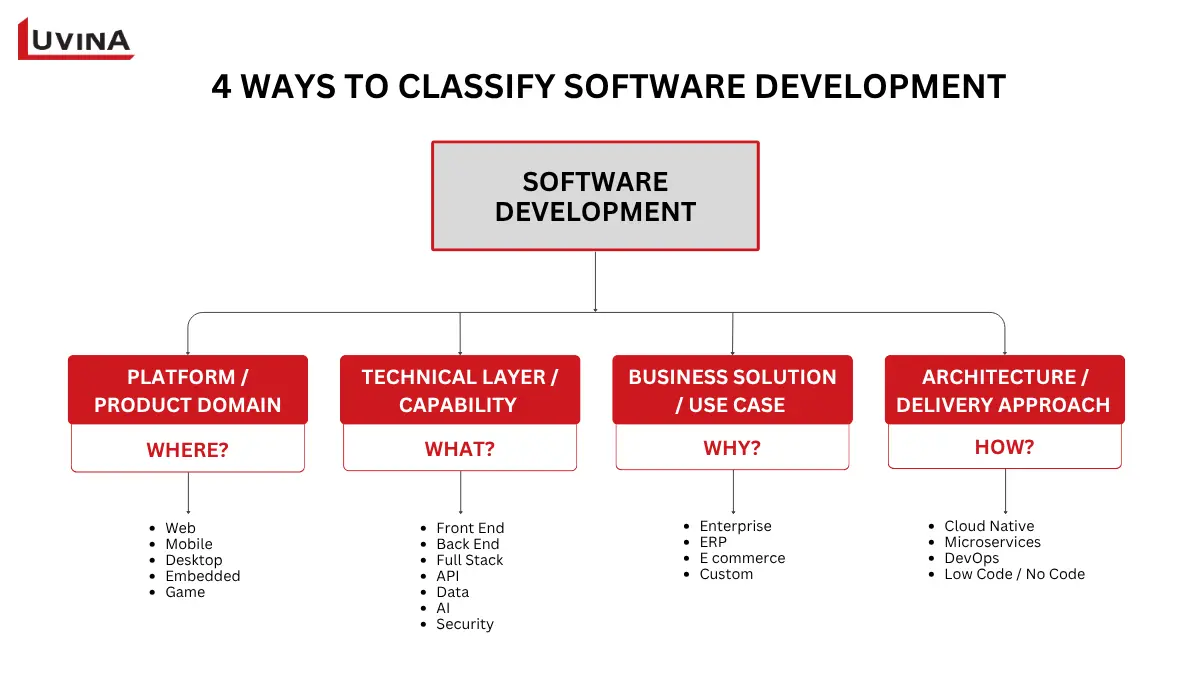
Why sources give different numbers of software development types
12 Common Types of Software Development
Software development can be classified in many ways, but for project planning, it’s often most practical to group it by the type of solution being built. The 12 development types below represent common project domains that organizations use to deliver digital products, modernize operations, or create new business capabilities.
While each type has its own purpose, they are not mutually exclusive. Modern software projects often combine multiple development types to meet business, technical, and operational requirements.
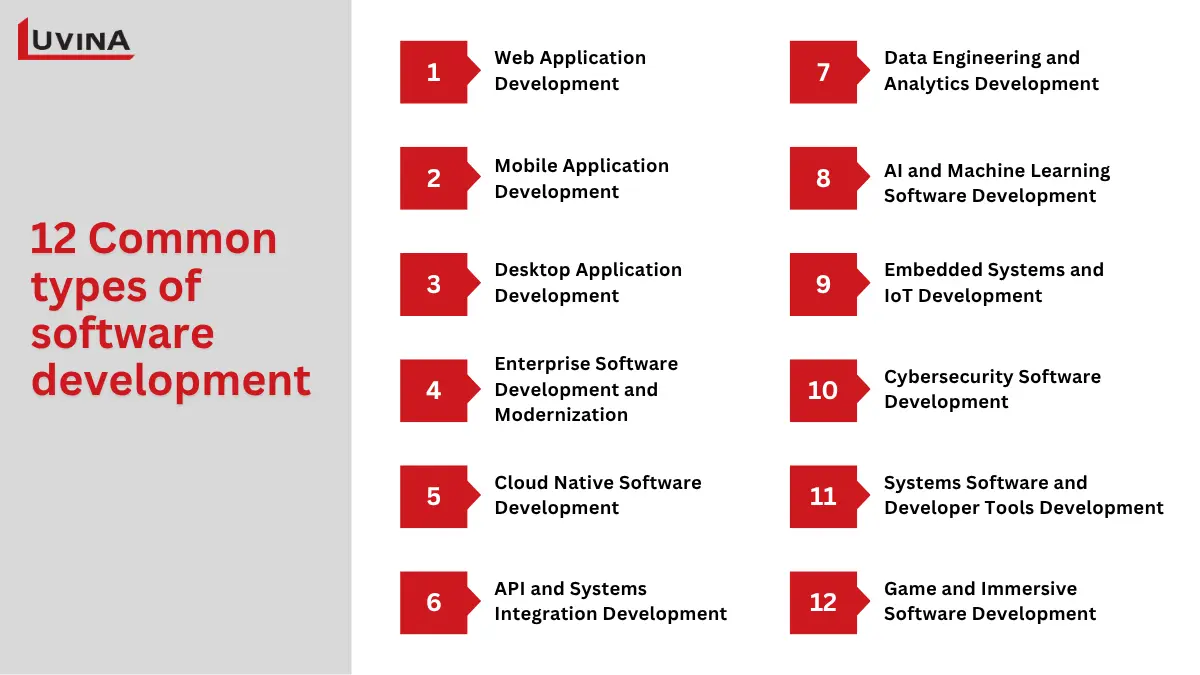
12 common types of software development every business should know
A. Application and Platform Development
Most software projects start by deciding where the application will run and how users will access it. This decision influences the user experience, technical architecture, and long-term maintenance strategy. The following development types represent the most common application and platform choices.
1. Web Application Development
Web application development focuses on building software that runs in a web browser instead of being installed directly on a device. Unlike front-end development, which only covers the user interface, web application development includes both the client-facing experience and the underlying application logic needed to deliver a complete solution.
- Best for: Customer portals, business dashboards, e-commerce platforms, internal systems, and other applications that need to work across multiple devices without installation.
- Typical deliverables: Web applications, customer and employee portals, progressive web apps (PWAs), e-commerce websites, and browser-based business tools.
- Common technology examples: HTML, CSS, JavaScript frameworks, server-side frameworks, REST APIs, GraphQL, and cloud hosting platforms. The technology stack always depends on project requirements.
- Main trade-off: Web applications are easy to deploy and update, but they must perform consistently across browsers, devices, and network conditions.
- Often combined with: API and systems integration, cloud native development, data engineering, and cybersecurity.
- Business example: A company launches a customer self-service portal where users can place orders, track deliveries, and manage invoices through a web browser. The application connects with ERP, payment, and CRM systems to provide a seamless experience.
Overall, web application development is the best choice when broad accessibility, centralized deployment, and seamless integration across business systems are top priorities.
2. Mobile Application Development
Mobile application development focuses on creating software for smartphones and tablets. Applications can be built as native apps for a specific operating system or as cross-platform apps that share much of the same code across iOS and Android.
- Best for: Applications that rely on mobile device features, push notifications, location services, frequent customer engagement, or offline functionality.
- Typical deliverables: Native iOS applications, Android applications, and cross-platform mobile apps.
- Common technology examples: Swift, Kotlin, Flutter, React Native, mobile APIs, cloud services, and mobile analytics platforms.
- Main trade-off: Mobile development requires support for multiple devices, operating system versions, app store approval processes, and continuous maintenance.
- Often combined with: API and systems integration, cloud native development, cybersecurity, data engineering, and AI.
- Business example: A retailer develops a mobile shopping app that enables customers to browse products, receive personalized offers, and complete purchases while synchronizing data with its web platform and CRM system.
For organizations that rely on customer engagement, mobility, or device-specific features, mobile applications can provide a more personalized and convenient user experience.
3. Desktop Application Development
Desktop application development creates software that runs primarily on desktop operating systems such as Windows, macOS, or Linux. Unlike browser-based applications, desktop software is installed locally and can provide greater access to hardware resources and offline functionality.
- Best for: Professional software, engineering applications, financial systems, offline workflows, and environments that require high performance or direct hardware access.
- Typical deliverables: Windows, macOS, and Linux applications, engineering tools, design software, and other desktop business applications.
- Common technology examples: .NET, Java, C++, Electron, Qt, and platform-specific desktop frameworks.
- Main trade-off: Desktop applications offer strong performance and offline capabilities but require software installation, version management, operating system compatibility, and ongoing desktop support.
- Often combined with: Cloud synchronization, APIs, data engineering, and cybersecurity.
- Business example: A manufacturing company develops a desktop application that engineers use to configure production equipment locally while synchronizing project data with cloud services whenever an internet connection is available.
Desktop application development remains a strong option for organizations that require high performance, offline capabilities, or close integration with local hardware.
4. Enterprise Software Development and Modernization
Enterprise software development focuses on large-scale systems that support business operations across departments and business functions. Projects often involve custom enterprise applications, legacy modernization, workflow automation, and integrations with ERP development and consulting services.
While Microsoft Dynamics 365 ERP applications is one of the most widely used ERP solutions, ERP itself is only one category of enterprise software, not a synonym for enterprise software development.
- Best for: Organizations that need to modernize legacy systems, improve business processes, integrate multiple business applications, or support digital transformation initiatives.
- Typical deliverables: Custom enterprise applications, workflow management systems, ERP and CRM integrations, legacy modernization projects, and internal business platforms.
- Common technology examples: Enterprise application frameworks, integration platforms, APIs, cloud services, databases, and workflow automation technologies.
- Main trade-off: Enterprise projects often involve complex integrations, data migration, governance requirements, organizational change management, and longer implementation lifecycles.
- Often combined with: API and systems integration, cloud native development, data engineering, cybersecurity, and web or mobile application development.
- Business example: A manufacturer modernizes a legacy order management system by integrating it with ERP, CRM, and warehouse management platforms, enabling employees across departments to access consistent, real-time business data.
When multiple business functions, users, and systems need to work together, enterprise software development provides the foundation for long-term operational efficiency and digital transformation.
5. Cloud Native Software Development
Cloud native software development focuses on building applications specifically for cloud environments rather than simply hosting traditional applications in the cloud. Common architectural patterns include containers, microservices, serverless computing, automation, and managed cloud services that improve scalability and operational efficiency.
- Best for: Applications that require scalability, resilience, rapid deployment, distributed development teams, or highly variable workloads.
- Typical deliverables: SaaS applications, cloud native business platforms, microservices-based systems, serverless applications, and cloud-first digital products.
- Common technology examples: Kubernetes, Docker, serverless platforms, managed databases, container orchestration, and cloud monitoring services.
- Main trade-off: Cloud native architectures improve flexibility and scalability but also increase complexity in system design, monitoring, cost management, and platform operations.
- Often combined with: Web application development, mobile application development, APIs, data engineering, AI, and DevOps practices.
- Business example: A SaaS provider redesigns its platform using a cloud native architecture, allowing it to scale automatically during peak traffic while releasing new features more frequently and reliably.
Organizations that expect continuous growth or frequent product releases often benefit most from a cloud native approach built for scalability and resilience from the start.
B. Integration, Data, and Intelligence Development
Many modern software projects depend on more than user-facing applications. They also require reliable data, seamless communication between systems, and intelligent capabilities that help businesses automate processes and make better decisions. The following development types focus on connecting applications, managing data, and turning information into business value.
6. API and Systems Integration Development
API and systems integration development focuses on enabling applications, platforms, and services to communicate and exchange data. Rather than creating a standalone product, this type of development connects existing systems, so they work together as a unified ecosystem. It also plays a critical role in cloud development services, where organizations need to integrate on-premises systems with cloud platforms and third-party applications.
- Best for: Organizations that need to connect enterprise applications, integrate third-party services, share data across systems, or expose business capabilities to partners and customers.
- Typical deliverables: APIs, middleware, integration services, event-driven architectures, API gateways, and system connectors.
- Common technology examples: REST APIs, GraphQL, gRPC, message queues, event streaming platforms, enterprise integration platforms, and API management tools.
- Main trade-off: Integration projects require careful API design, version management, security, reliability, and ongoing coordination between connected systems.
- Often combined with: Nearly every other software development type, especially enterprise software, web and mobile applications, cloud native development, data engineering, and AI.
- Business example: An e-commerce company integrates its online store with ERP, payment gateways, warehouse management, and shipping providers, so inventory, orders, and delivery information remain synchronized in real time.
API and systems integration development is often the foundation that allows multiple business applications to operate as one connected digital platform.
7. Data Engineering and Analytics Development
Data engineering and analytics development focuses on building the infrastructure that collects, transforms, stores, and delivers data for reporting, analytics, and AI. Organizations investing in data engineering consulting often do so to modernize fragmented data environments, improve data quality, and build reliable foundations for analytics and AI.
Unlike database development, which is more about how data is stored, data engineering ensures that data flows reliably across systems and is ready for business use.
- Best for: Organizations that need trusted data for reporting, business intelligence, regulatory compliance, forecasting, or AI initiatives.
- Typical deliverables: Data pipelines, data warehouses, data lakes, ETL and ELT processes, analytics platforms, and reporting foundations.
- Common technology examples: Apache Spark, Kafka, Snowflake, Databricks, Microsoft Fabric, Azure Data Factory, cloud data warehouses, and business intelligence platforms.
- Main trade-off: Data engineering projects require strong governance, data quality management, lineage tracking, and integration across multiple data sources, which can increase implementation complexity.
- Often combined with: Enterprise software, cloud native development, API and systems integration, and AI or machine learning applications.
- Business example: A retailer consolidates sales, inventory, and customer data from multiple business systems into a centralized analytics platform, allowing executives to monitor performance through real-time dashboards.
Organizations that want to make faster and more informed decisions often need a strong data engineering foundation before expanding into advanced analytics or AI.
8. AI and Machine Learning Software Development
AI and machine learning software development focuses on building applications that use trained models to predict outcomes, generate content, classify information, recommend actions, or automate decision-making. This is different from developers using AI coding assistants, which help write software but do not make the software itself AI-powered.
- Best for: Business problems with clear objectives, reliable data, measurable outcomes, and opportunities to improve efficiency or customer experience through intelligent automation.
- Typical deliverables: AI-powered applications, recommendation engines, chatbots, computer vision systems, predictive analytics solutions, and intelligent automation platforms.
- Common technology examples: Large language models, TensorFlow, PyTorch, Azure AI services, vector databases, and machine learning platforms.
- Main trade-off: AI projects depend heavily on data quality, model evaluation, governance, privacy, ongoing monitoring, and continuous improvement after deployment.
- Often combined with: Data engineering, cloud native development, API and systems integration, web, mobile, or enterprise applications.
- Business example: A financial services company builds an AI-powered assistant that helps customer service teams answer inquiries faster by retrieving information from internal knowledge bases while maintaining security and human oversight.
AI and machine learning work best when they are integrated into broader business systems rather than implemented as standalone technologies.
C. Specialized Systems Development
Some software is built for highly specialized environments rather than general business applications. These projects often involve close interaction with hardware, security, operating systems, or real-time graphics. As a result, they typically require specialized expertise and are frequently combined with cloud, data, and enterprise technologies to deliver complete solutions.
9. Embedded Systems and IoT Development
Embedded systems and IoT development focus on software that runs on physical devices or connects sensors, machines, and other hardware to digital platforms. Unlike traditional applications, embedded software often operates with limited computing resources and interacts directly with the physical world.
- Best for: Connected products, industrial automation, smart factories, medical devices, automotive systems, and other solutions that rely on hardware control or sensor data.
- Typical deliverables: Firmware, embedded software, IoT platforms, edge applications, and connected device management systems.
- Common technology examples: C, C++, Rust, embedded Linux, RTOS, MQTT, OPC UA, edge computing platforms, and IoT cloud services.
- Main trade-off: Embedded systems must balance hardware limitations, real-time performance, reliability, device security, and long-term maintenance across deployed devices.
- Often combined with: Cloud native development, data engineering, AI, enterprise software, and cybersecurity.
- Business example: A manufacturer deploys IoT sensors across production lines to collect machine data, detect equipment anomalies, and send real-time information to cloud-based monitoring systems.
Embedded and IoT development is the right choice when software must interact directly with physical devices while remaining connected to broader digital platforms.
10. Cybersecurity Software Development
Cybersecurity software development focuses on building products whose primary purpose is protecting systems, applications, users, and data. Examples include identity management, threat detection, encryption, vulnerability management, and security automation tools. This is different from IT security services, which focus on protecting existing software and infrastructure rather than developing security products.
- Best for: Organizations developing security products or platforms that detect, prevent, monitor, or respond to cyber threats.
- Typical deliverables: Identity and access management solutions, endpoint protection software, security monitoring platforms, encryption tools, and security automation systems.
- Common technology examples: Encryption libraries, SIEM platforms, zero trust architectures, identity providers, security analytics platforms, and threat intelligence tools.
- Main trade-off: Security software must maintain high reliability while adapting to constantly evolving threats, strict compliance requirements, and the need to minimize false positives.
- Often combined with: Cloud native development, APIs, data engineering, AI, and enterprise software.
- Business example: A financial institution develops a security platform that continuously monitors user activity, detects suspicious behavior, and automatically triggers additional identity verification when potential threats are identified.
Organizations building security-focused products often require specialized expertise beyond traditional software development. Businesses looking to strengthen existing applications can also benefit from IT security services that address security assessment, protection, and ongoing risk management.
11. Systems Software and Developer Tools Development
Systems software and developer tools development focuses on software that supports operating systems, hardware platforms, and the software development process itself. These products provide the foundation that other applications and developers rely on.
- Best for: Products that operate close to hardware, optimize development workflows, or provide core platform capabilities.
- Typical deliverables: Operating system components, runtime environments, compilers, SDKs, IDE extensions, build tools, testing frameworks, and developer platforms.
- Common technology examples: C, C++, Rust, LLVM, Java Virtual Machine, .NET Runtime, compiler toolchains, and CI/CD platforms.
- Main trade-off: These projects require deep technical expertise, long-term compatibility, high performance, and exceptional reliability because many other systems depend on them.
- Often combined with: Embedded systems, cloud infrastructure, cybersecurity, and APIs.
- Business example: A software company develops an internal build automation platform that helps engineering teams compile, test, and deploy applications more efficiently across multiple development environments.
Systems software and developer tools are essential for organizations building complex technology platforms or improving software engineering productivity at scale.
12. Game and Immersive Software Development
Game and immersive software development focuses on creating highly interactive experiences such as video games, simulations, augmented reality (AR), and virtual reality (VR) applications. These products often require real-time rendering, physics simulation, and responsive user interactions.
- Best for: Entertainment products, employee training simulations, digital twins, AR or VR experiences, and applications where immersive interaction is central to the user experience.
- Typical deliverables: Video games, simulation software, AR and VR applications, interactive training platforms, and immersive visualization tools.
- Common technology examples: Unity, Unreal Engine, OpenXR, graphics APIs, physics engines, cloud gaming platforms, and spatial computing frameworks.
- Main trade-off: These projects demand significant expertise in graphics optimization, performance tuning, content production, and support for multiple devices and platforms.
- Often combined with: Cloud services, mobile or desktop development, AI, and data analytics.
- Business example: A manufacturing company develops a VR training application that allows technicians to practice complex maintenance procedures in a virtual environment before working with real equipment.
Game and immersive software development extends well beyond entertainment, enabling organizations to improve training, visualization, collaboration, and customer engagement through interactive digital experiences.
Types of Software Development at a Glance
The 12 software development types above each serve different business needs, but they are rarely used in isolation. The comparison below provides a quick overview of when each type is most appropriate, where it typically runs, and which other development domains it is commonly combined with.
| Type | Best when | Runs where | Main trade-off | Often combined with |
|---|---|---|---|---|
| Web Application Development | Users need broad access across devices without installing software | Web browser | Browser compatibility and network dependency | API integration, Cloud Native, Data Engineering, Cybersecurity |
| Mobile Application Development | Users rely on smartphones, device features, or offline access | iOS and Android devices | Device fragmentation and ongoing maintenance | APIs, Cloud Native, AI, Cybersecurity |
| Desktop Application Development | High performance, offline workflows, or hardware integration are required | Windows, macOS, Linux | Installation, OS compatibility, and version management | Cloud, APIs, Data Engineering, Cybersecurity |
| Enterprise Software Development and Modernization | Organizations need to improve business processes or modernize legacy systems | Enterprise environments | Integration complexity, data migration, and change management | APIs, Cloud Native, Data Engineering, Web/Mobile, Cybersecurity |
| Cloud Native Software Development | Scalability, resilience, and rapid delivery are priorities | Cloud platforms / distributed cloud environments | Distributed system complexity and cost governance | Web, Mobile, APIs, Data Engineering, AI, DevOps |
| API and Systems Integration Development | Multiple systems need to exchange data or functionality | Across applications and platforms | Versioning, security, and dependency management | Nearly all development types |
| Data Engineering and Analytics Development | Reliable data is needed for reporting, analytics, or AI | Cloud and enterprise data platforms | Data quality, governance, and integration | Enterprise Software, APIs, Cloud Native, AI |
| AI and Machine Learning Software Development | Businesses want to automate decisions or generate insights | Cloud, enterprise, web, and mobile applications | Model reliability, governance, and ongoing monitoring | Data Engineering, APIs, Cloud Native, Enterprise Software |
| Embedded Systems and IoT Development | Software interacts directly with hardware or sensors | Devices, edge systems, IoT platforms | Hardware constraints and real-time performance | Cloud, Data Engineering, AI, Enterprise Software, Cybersecurity |
| Cybersecurity Software Development | Building products that protect systems and data | Enterprise, cloud, and security platforms | High assurance, evolving threats, and compliance | Cloud Native, APIs, AI, Enterprise Software |
| Systems Software and Developer Tools Development | Building platform software or tools for developers | Operating systems and development environments | Performance, compatibility, and technical complexity | Embedded Systems, Cloud Infrastructure, APIs, Cybersecurity |
| Game and Immersive Software Development | Interactive graphics, simulations, AR, or VR are core requirements | Mobile, desktop, consoles, AR/VR devices | Performance optimization and content creation | Cloud Services, AI, Data Analytics, Mobile/Desktop Development |
Comparison of 12 common software development types
Understanding each development type is only the first step. In practice, successful software products are built by combining multiple development domains based on business and technical requirements.
How Real Software Products Combine Multiple Development Types
Although classifying software projects into different development types is useful, real-world applications rarely fit into just one category. Most projects require a combination of capabilities to meet business goals, technical requirements, and long-term scalability. Looking at these combinations also helps organizations define project scope more accurately and identify the expertise needed for successful delivery.
The examples below illustrate how several software development types often work together within a single project.
| Project | Common Development Types Combined | Why They Work Together |
|---|---|---|
| Mobile banking application | Mobile + API & Systems Integration + Cloud Native + Cybersecurity + AI & Data Engineering | Mobile apps provide customer experience, APIs connect banking systems, cloud infrastructure enables scalability, cybersecurity protects sensitive financial data, and AI supports fraud detection and personalized services. |
| Enterprise modernization | Enterprise Software + API & Systems Integration + Cloud Native + Data Engineering + Cybersecurity | Modernizing legacy systems often requires integrating existing business applications, migrating data, strengthening security, and adopting cloud architectures. Many organizations begin this journey with software re-engineering and modernization to extend the value of existing systems while reducing migration risks. |
| Smart factory platform | Embedded Systems & IoT + Cloud Native + Data Engineering + AI + Enterprise Software | Connected devices collect operational data; cloud platforms process it; AI generates predictive insights, and enterprise systems integrate production data with broader business operations. |
| Customer self-service portal | Web Application + API & Systems Integration + Cloud Native + Cybersecurity | Customers access services through a web portal while APIs connect to ERP, CRM, payment, and other back-end systems. Cloud infrastructure improves scalability, while cybersecurity protects customer accounts and transactions. |
Common combinations of software development types in real-world projects
These examples show that choosing the right software development approach is rarely about selecting a single category. Instead, the real challenge is understanding which capabilities your project needs and how they work together. The next section walks through the key questions that can help you make that decision.
How to Choose the Right Type of Software Development for Your Project
Choosing the right type of software development starts with understanding your business goals rather than selecting a technology. By answering the following questions in sequence, you can identify the capabilities your project truly needs and make more informed technical decisions.
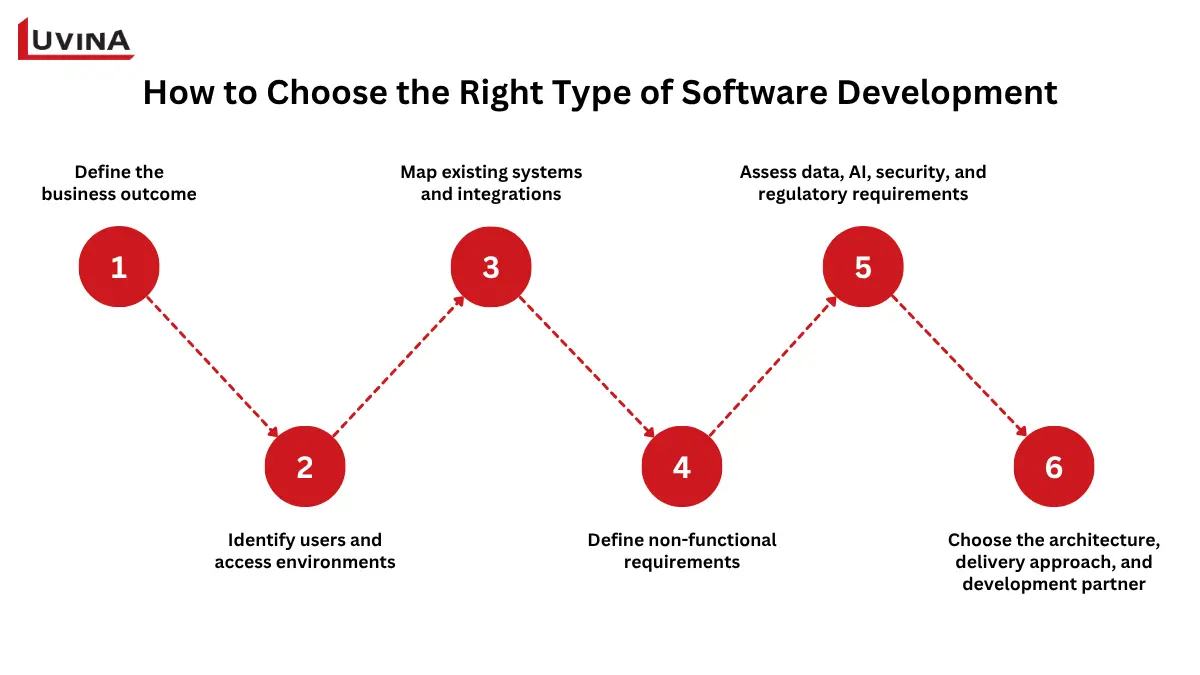
6 Steps to Choose the Right Software Development Type
1. Define the business outcome
Start by identifying the business problem you want to solve and the value you expect to create. Whether your objective is improving customer experience, increasing operational efficiency, reducing costs, or launching a new digital product, business outcomes should drive technology decisions, not the other way around.
2. Identify users and access environments
Next, consider who will use the software and where they will access it. Your users may interact through a web browser, mobile app, desktop application, connected device, internal enterprise system, or a combination of multiple channels.
Understanding the user’s journey helps narrow down the most appropriate development types before evaluating specific technologies.
3. Map existing systems and integrations
Most business applications need to exchange data with existing systems. Before choosing a development approach, identify all integration points, including ERP, CRM, legacy applications, third-party services, APIs, and data platforms.
Integration requirements often have a significant impact on project scope, architecture, and implementation effort. For example, this ERP optimization with Dynamics 365 Business Central case study demonstrates how integrating ERP with core business processes helped streamline operations and improve overall efficiency.
4. Define non-functional requirements
Functional requirements describe what the software should do, while non-functional requirements define how well it should perform.
Consider factors such as scalability, availability, performance, response time, offline capabilities, maintainability, security, and hardware compatibility. Addressing these requirements early helps avoid costly architectural changes later in the project.
5. Assess data, AI, security, and regulatory requirements
If your project relies on analytics or AI, evaluate whether your data is accurate, accessible, and properly governed. At the same time, identify any privacy, security, or regulatory requirements that could influence system design.
Planning these requirements from the beginning reduces implementation risks and creates a stronger foundation for future growth.
6. Choose the architecture, delivery approach, and development partner
Once your business objectives and technical requirements are clear, you can determine the most suitable architecture and delivery approach. Depending on the project, this may include cloud native architectures, microservices, Agile delivery, DevOps practices, or low-code platforms.
Equally important is selecting a development partner with experience across the combination of capabilities your project requires, rather than expertise in just one software development type.
FAQs
1. How many types of software development are there?
There is no universal number. Different sources use different classification methods, so this guide focuses on 12 common project domains that are most useful for project planning.
2. What are the 4 main types of software development?
They are: platform, technical capability, business solution, and architecture or delivery approach. This is a useful framework, but it is not an industry standard.
3. What is the difference between software development types and methodologies?
Software development types describe what is being built, while methodologies describe how the work is managed and delivered, such as Agile or Waterfall.
4. Can one project use multiple types of software development?
Yes. Most modern software products combine several development types, such as web or mobile applications with APIs, cloud services, data platforms, and cybersecurity.
5. Which types of software development are in demand?
Demand continues to grow for AI, cybersecurity, cloud native development, data engineering, and IoT, driven by digital transformation and increasing software adoption across industries.
6. What type of software development is best for a startup?
It depends on your product goals, target users, integration needs, and technical requirements. Most startups use a combination of development types rather than relying on a single approach.
Conclusion
There is no universal number of types of software development, and most modern software products combine multiple development domains rather than relying on a single approach. The best choice starts with your business goals, users, existing systems, technical requirements, and long-term priorities.
If the next step is selecting a development partner, this guide on how to evaluate software engineering companies can help you compare providers and make a more informed decision.
READY TO START A PROJECT?
Our experts are eager to explore your needs.

Read More From Us?
Sign up for our newsletter
Read More From Us?
Sign up for our newsletter